
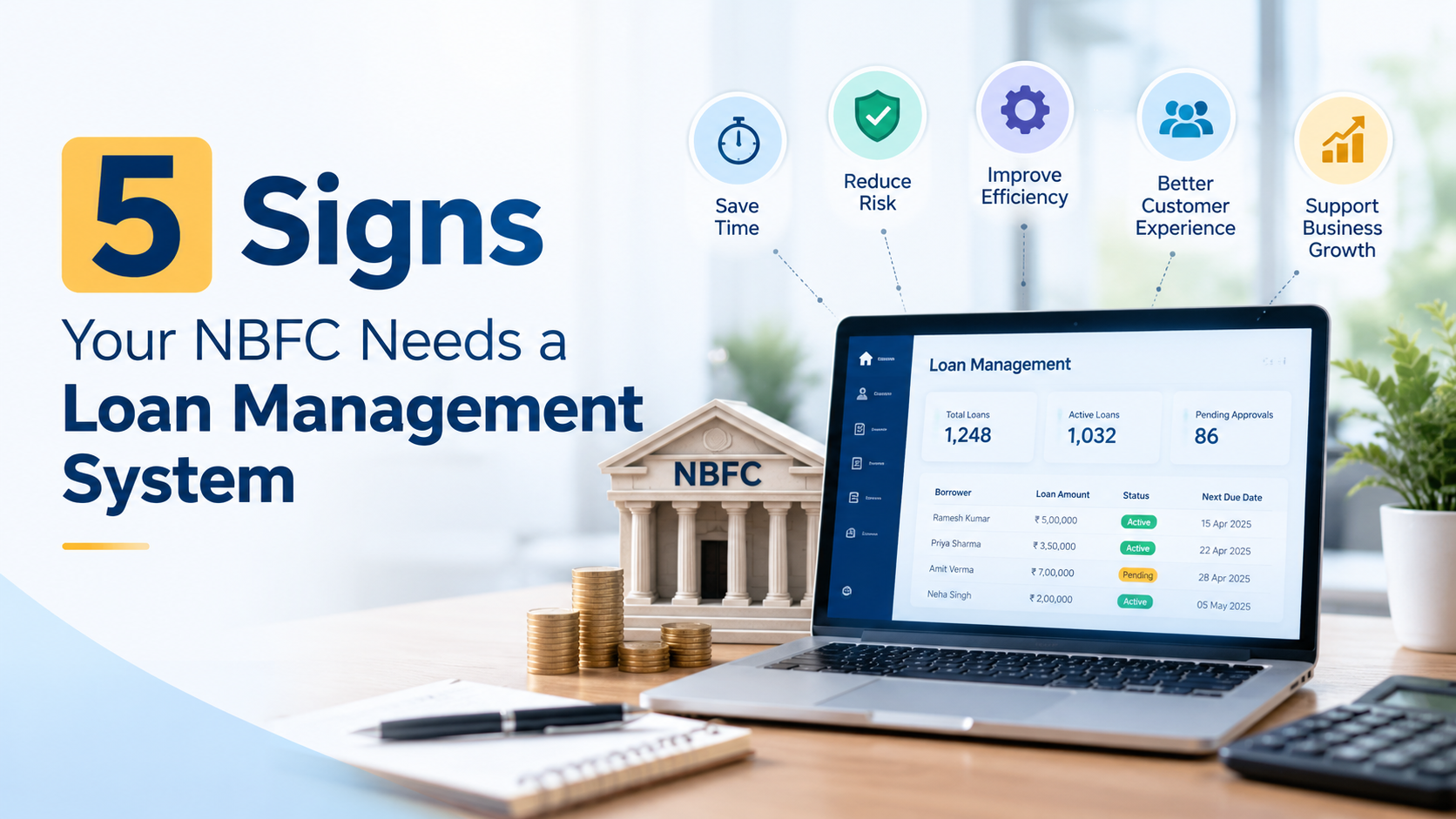
If you run an NBFC, you already know the feeling. Things were manageable when you had a couple of hundred borrowers and a small team that knew every file by heart. Somewhere along the way, though, the spreadsheets multiplied, the WhatsApp reminders became a full-time job, and compliance started eating into hours you used to spend actually growing the business. That shift is not a coincidence. It is what happens to almost every NBFC once loan volumes cross a certain point.
So how do you know you have actually reached that point? Here are five signs worth paying attention to, explained the way you would actually experience them, not the way a sales deck would.
What is a Loan Management Software?
A Loan Management System, or LMS, is essentially the software layer that takes charge once a loan gets approved and disbursed. From that point on, it handles the scheduling of payments, manages collections, keeps compliance records in order, and takes care of ongoing reporting, so your team is not stitching everything together by hand every single month.
5 Reasons Your NBFC Needs a Loan Management System
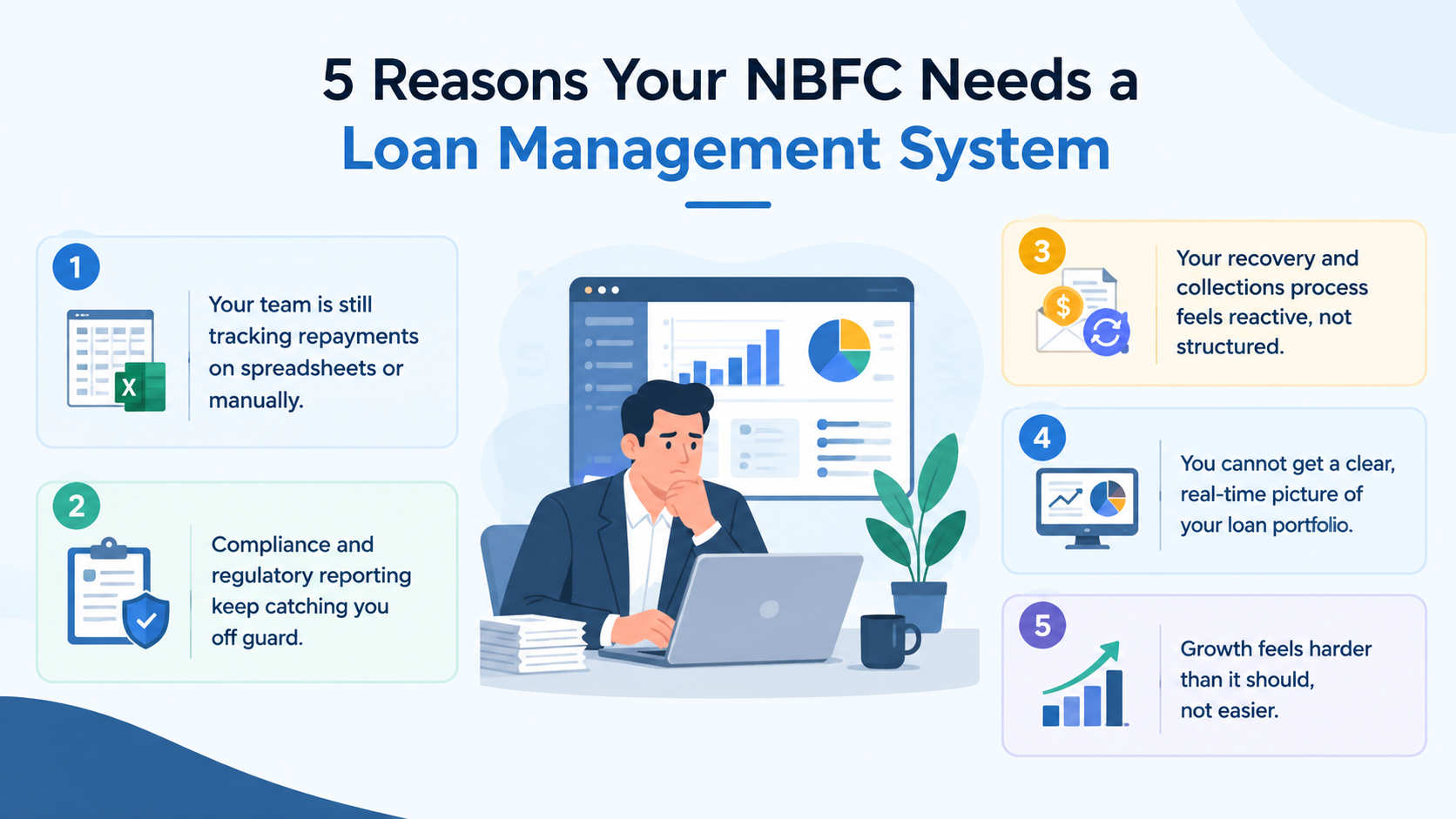
1. Your team is still tracking repayments on spreadsheets or manually
If your team is manually updating due dates, chas
Under these Directions, NBFCs now have to:ing EMI records across different files, or reconciling collections at the end of every month with a mix of bank statements and personal notes, that is not a workflow problem you can fix with more discipline. It is a structural one. An LMS digitises the entire loan lifecycle, so nothing depends on someone remembering to update a cell.
This pattern shows up so often that it has almost become a rite of passage for NBFCs. In the beginning, spreadsheets or manual tracking genuinely do the job because there simply is not much to track. But as the borrower base grows, repayment tracking starts eating into hours nobody had budgeted for, compliance work turns into something closer to a full-time role rather than a side task, and the paperwork just seems to multiply on its own.
2. Compliance and regulatory reporting keep catching you off guard
This one has become far more serious in the last year or so, and honestly, it deserves more attention than it usually gets. The Reserve Bank of India issued the Digital Lending Directions, 2025 on 8 May 2025, and they consolidated years of fragmented rules into a single enforceable framework covering banks, NBFCs, and their fintech partners.
Under these Directions, NBFCs now have to:
- Report every Digital Lending App (DLA) they use, whether it is owned directly or operated through a lending partner, on the RBI’s Centralised Information Management System (CIMS).
- Keep the reported information up to date and promptly update the details whenever there are any changes.
- Ensure accurate reporting, with the Chief Compliance Officer responsible for certifying that the information submitted is accurate.
- Meet the 15 June 2025 registration deadline for reporting Digital Lending Apps on CIMS.
- Maintain a board-approved digital lending policy as part of their digital lending compliance requirements.
- Keep contracts with lending partners updated to align with the applicable regulatory requirements.
By early 2026, NBFCs that had not completed these requirements were not simply falling behind on an optional best practice. They could be operating outside an active regulatory requirement.
A proper LMS builds compliance checks and audit trails directly into the workflow instead of treating them as an afterthought that someone must remember.
3. Your recovery and collections process feels reactive, not structured
Here is something that tends to surprise people who are new to lending operations. It is not the loan disbursal that breaks down first when volumes grow. It is collections.
Manual Follow-Ups: When you are handling a handful of loans, following up on a missed payment is simple. You call, you remind, you sort it out. But once you are managing hundreds or thousands of accounts, ad-hoc follow-ups stop working.
Structured Collections: Since recovery performance tends to improve noticeably once NBFCs move away from case-by-case follow ups and toward a structured, rule-based collections workflow. Without that structure, delinquent accounts slip through the cracks simply because nobody flagged them in time, not because your team was careless.
Collection Challenges: If you find that overdue accounts are discovered too late, that different staff members follow different recovery processes, or that you genuinely cannot say with confidence what your current delinquency rate is without pulling multiple reports together, that is your collections process telling you it has outgrown manual management.
An LMS automates reminders, flags overdue accounts early, and gives you a single, reliable view of where every loan actually stands.
4. You cannot get a clear, real-time picture of your loan portfolio
Ask yourself something simple. If your CFO or your board asked you right now for the current health of your loan portfolio, how long would it take to put that together accurately? If the honest answer is hours, or worse, a couple of days of pulling data from different sources, that is a real problem hiding in plain sight.
This is where the absence of an LMS quietly hurts growing NBFCs the most:
Data-Driven Decisions: Decisions about risk, pricing, and where to focus collections, all depend on having current data, not last month’s snapshot.
Real-Time Insights: Modern loan management platforms are built specifically to solve this, since they integrate analytics tools that generate real-time insights on borrower behaviour, loan performance, and market trends, which is exactly the kind of visibility that scattered spreadsheets simply cannot provide.
Operational Efficiency: Beyond just visibility, there is also the operational cost of not having it. When information is not scattered across five different tools and files, day to day operations genuinely become easier to run, and teams end up spending far less time reconciling numbers and far more time working on growth.
If your team’s time is going into reconciliation instead of strategy, that time is not coming back, and it is a reliable sign that your current tools have hit their ceiling.
5. Growth feels harder than it should, not easier
This is the sign that ties everything together, and it is often the one that finally pushes NBFCs to make the switch. Growth is supposed to get easier as you scale, not harder. More borrowers should mean more efficient operations, not more chaos. If every new loan product, every new city you expand into, or every new borrower segment adds noticeably more manual work rather than just more volume, your systems are the bottleneck, not your strategy.
A well-built LMS is designed around this exact problem. A strong loan management foundation matters because it allows NBFCs to expand their portfolios without constantly worrying about operational strain, which is really the whole point of investing in one in the first place. Similarly, another breakdown notes that whether an NBFC is handling a few hundred accounts or scaling toward millions, the right platform should support that growth without performance bottlenecks getting in the way.
If your team dreads the idea of onboarding a new lending partner, adding a new loan type, or entering a new market because it means more manual firefighting, that dread is worth listening to. It usually means the system underneath your operations was built for a smaller version of your business.
Conclusion
None of these five signs show up in isolation, and that is exactly why they are easy to miss for a while. A spreadsheet-based process leads to messier collections. Messier collections make compliance reporting harder. Harder compliance reporting slows down growth. It is a chain reaction, and by the time it becomes obvious, it has usually already cost the business real time and real money.
The good news is that recognising these patterns early gives you room to act on your own timeline rather than being forced into a rushed decision during an audit or a growth spurt you were not ready for. A Loan Management System is not really about replacing your team’s judgement. It is about removing the manual grind so your team’s judgement can actually be put to good use, on borrowers and strategy, instead of on spreadsheets and reconciliation.
Your questions, our answers
A Loan Management System (LMS) is software that helps NBFCs manage the loan lifecycle after approval and disbursal. It can handle repayment schedules, collections, overdue tracking, borrower records, reporting, and other lending operations from a central platform.
An NBFC should consider an LMS when manual processes start affecting daily operations. Frequent spreadsheet errors, time-consuming reconciliation, delayed collections, compliance challenges, and difficulty getting real-time portfolio data are common indicators that it may be time to adopt one.
Yes. An LMS can automate repayment schedules, payment reminders, overdue alerts, collection workflows, and other routine activities. This reduces the amount of manual follow-up required from the collections team.
An LMS can maintain organised loan records, create audit trails, support required reports, and standardise compliance-related workflows. This makes it easier for teams to track information and prepare for regulatory reporting and audits.
Yes. A properly designed LMS can support increasing numbers of borrowers, loans, transactions, and repayment activities without requiring the same increase in manual work. This makes it easier for an NBFC to scale its operations.
Important features can include loan servicing, repayment scheduling, automated collections, overdue management, borrower management, reporting and analytics, audit trails, compliance support, integrations, role-based access, and scalability.
Spreadsheets require employees to manually enter, update, reconcile, and track loan information. An LMS centralises these processes and can automate routine tasks, reducing dependence on manual data entry and making loan information easier to monitor.