

Picture a regular Saturday morning at almost any sports academy. A coach is juggling three different WhatsApp groups on his phone. A parent is texting to ask where the fixture list went. Somebody is still chasing last month’s fees. And the volunteer who handles admin is trying to figure out which spreadsheet actually has the latest attendance numbers. Meanwhile, the kids are already on the field, just waiting for someone to show up and coach them.
That scene isn’t rare. It’s honestly the default. And there’s nothing embarrassing about it either, because this is just what running a sports academy actually looks like at the volume most of them operate at.
But here’s the thing. What works beautifully for a small academy starts creaking under its own weight the moment things grow. Let’s actually walk through why that happens, because it’s a lot more interesting (and human) than it sounds.
WhatsApp and Excel aren’t the Villains Here
It’s tempting to blame the tools. But that’s not really fair, and honestly, it’s not accurate either.
Think about why an academy owner reaches for WhatsApp in the first place. It’s clearly the right one, because coaches and parents are already living in it. Nobody needs to download a new app or remember another password.
Same goes for spreadsheets. Almost every academy begins on a spreadsheet, and for good reason, since it’s free, familiar, and flexible enough to track a handful of students, a simple fee list, and a basic weekly schedule. For a small, single-coach setup, Excel genuinely does the job.
So, the problem was never really about picking the wrong tool. It’s about what happens when the tool keeps being used the exact same way while everything around it gets bigger and messier.
The Cracks Start Small, Then They Don’t
As student enrollments grow, the limitations of manually managing a sports academy become increasingly difficult to ignore. Tools like WhatsApp, spreadsheets, and paper registers may work well for smaller batches, but they can create operational challenges as an academy expands.
Here are five ways these everyday tools can start holding your academy back:
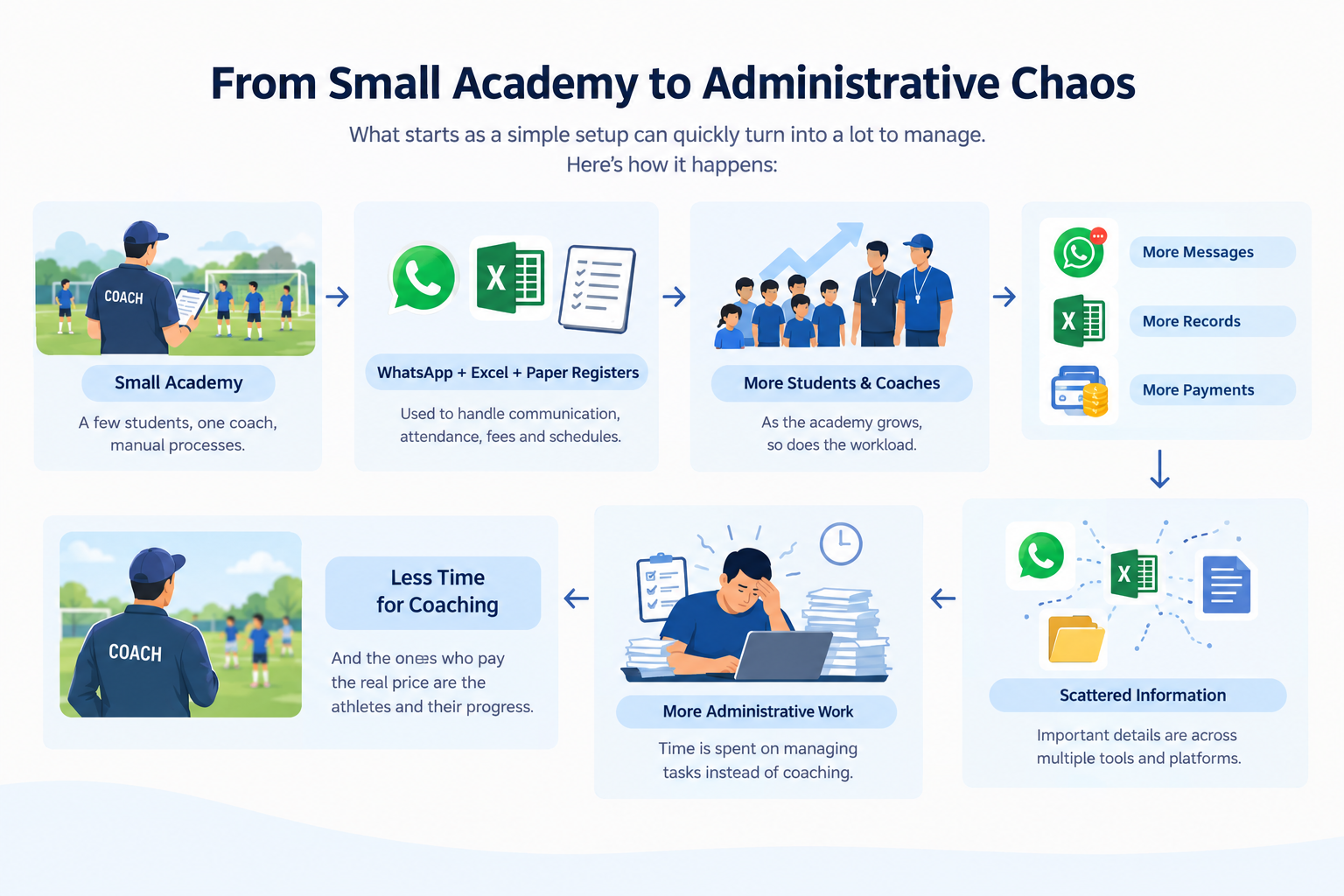
1. WhatsApp Becomes Difficult to Manage: WhatsApp works well for communicating with a small group of students and parents. However, as enrollments increase, managing multiple groups, tracking conversations, and keeping everyone informed becomes more complicated. Without a structured system, important updates can get lost among hundreds of messages.
2. Coaches Spend More Time on Administration: As the academy grows, coaches may find themselves spending valuable hours responding to messages, updating attendance records, tracking fees, and coordinating schedules. Instead of focusing on training and player development, they end up handling administrative responsibilities that could otherwise be streamlined.
3. Spreadsheets Become Increasingly Complicated: Managing student records through spreadsheets may seem convenient initially. But more students mean more rows, more coaches mean more people editing the same files, and additional sports or branches mean more spreadsheets to maintain. Keeping everything accurate and updated becomes increasingly challenging.
4. Information Gets Scattered Across Multiple Tools: When attendance is recorded in one spreadsheet, fee payments are tracked in another, and communication happens through WhatsApp, important information becomes scattered across different platforms. Finding the right details, identifying discrepancies, and keeping records consistent can take considerable time and effort.
5. The System Struggles to Keep Up with Growth: The biggest challenge is that these tools were never designed to manage every aspect of a growing sports academy. What once made daily operations easier can gradually become a source of extra work. The problem isn’t necessarily that WhatsApp or spreadsheets are ineffective. It’s that your academy has grown beyond what these tools can comfortably manage.
The Chaos Hiding in Plain Sight
Let’s get specific, because vague complaints about “disorganisation” don’t really capture it. Here’s what actually goes wrong day to day.
A Single Missed Message Becomes a Cascading Mess: One coach updates a group about a pitch closure. Another coach assumes someone already sent it. A league fixture shifts, one coach updates a WhatsApp group, another forwards an old email, and by Monday morning parents are asking which time is correct. It seems tiny in isolation. But multiply that across a season and it becomes a genuine trust problem between the academy and the families it serves.
Group Chats Turn into Noise, Not Information: This is the part almost every academy owner recognizes instantly. A 200 member WhatsApp group where fee announcements get buried under forwarded videos and good morning messages is not really a communication system anymore. It’s just noise with important things occasionally floating past.
Nobody can Actually Answer Simple Questions Quickly: Try this thought experiment. How many athletes attended your Monday 6 AM batch in February? What’s your average attendance rate this quarter? Which batch has the highest dropout rate? If those questions send you digging through a spreadsheet for half an hour, that’s not a minor inconvenience. It means decisions end up based on gut feeling rather than actual evidence, which sounds fine until you realize you might be running a nearly empty batch just because it “feels” popular, while a genuinely full one somewhere else needs another coach and nobody’s noticed.
Fee Collection Quietly Eats Entire Days: This one surprised me a bit when I first read the numbers. Fee reconciliation alone can consume three to five hours per week for managers handling over a hundred athletes. That’s time pulled directly away from coaching, from growth, from literally anything more useful than chasing payments through a chat thread.
The Human Cost Nobody Puts on a Slide
Here’s the part that actually gets me a little. This isn’t just about efficiency. It’s about the people who show up every day because they genuinely love coaching.
- A 2023 study by the National Alliance for Youth Sports found that 65% of youth coaches name administrative duties as a key reason for leaving coaching. Not burnout from the sport itself. Not losing interest in the kids. Paperwork. Scheduling. Endless message threads.
- A separate survey from the Aspen Institute’s Project Play found that 60% of coaches feel overwhelmed by non-coaching tasks, which significantly hinders their effectiveness in mentoring young athletes.
- And when experienced coaches walk away, it isn’t just an HR problem for the academy. Young athletes lose the guidance they need to reach their full potential, and teams face inconsistent training and development.
So really, the spreadsheet-and-chat-group grind isn’t just inefficient. It’s quietly pushing good coaches out the door.
What “Outgrowing It” Actually Looks Like
If you are running an academy right now, here are the honest signs that you’ve crossed the line from manageable to unsustainable.
Your phone doesn’t stop buzzing with the same handful of questions repeated by different parents. If your phone is flooded with messages asking about schedules, batch timings, holidays, or make up sessions, your communication system needs an overhaul.
Records live in someone’s head instead of on paper. Paper registers get lost, damaged, or forgotten at home, and WhatsApp screenshots are impossible to aggregate into monthly reports. When information depends on memory rather than a system, athletes eventually slip through the cracks without anyone meaning for it to happen.
One person becomes a single point of failure. In many small academies, everything from attendance to fee tracking runs through a head coach’s phone. If that person is sick, on holiday, or simply overwhelmed for a week, the whole operation wobbles.
So, What’s the Actual Fix
Instead of stitching together WhatsApp, spreadsheets, and paper registers, dedicated sports academy management software brings attendance, fees, scheduling, and communication into one system.
Here are five practical ways academies can make that transition:
1. Separate Communication from Administrative Management: WhatsApp can continue to serve as a communication channel for coaches, students, and parents. However, important administrative information shouldn’t get buried in endless conversations. Separating announcements, urgent updates, and administrative records can make communication easier to manage.
2. Automate Routine Fee Reminders: Instead of manually contacting parents whenever a payment is due, academies can introduce automated fee reminders. This reduces repetitive follow-ups, helps keep payment schedules organised, and allows staff to focus on other responsibilities.
3. Create a Single Source of Truth for Records: Maintaining multiple spreadsheets across different devices can lead to outdated information and inconsistencies. Using a centralised system for attendance, student records, and scheduling helps ensure that coaches and administrators can access the same updated information.
4. Introduce Structure as the Academy Grows: A management approach that works for twenty students may not be suitable for two hundred. As enrollments increase, academies need to review their existing processes and introduce systems that can accommodate additional students, coaches, sports, and branches without creating unnecessary administrative work.
5. Recognise When Manual Processes Stop Saving Time: One of the most important steps is identifying when existing tools have become more of a burden than a convenience. This isn’t a failure on the academy owner’s part. It’s a natural part of growth, much like a small shop eventually needing a proper billing system instead of relying on a cash box under the counter.
Summarizing It
WhatsApp groups and spreadsheets have their place in sports academy management. They are affordable, familiar, and often perfectly adequate when an academy is just getting started. But as student enrollments increase, coaches multiply, and operations become more complex, relying entirely on manual processes can create more work than they save.
The solution isn’t about replacing every familiar tool overnight. It’s about recognising when your academy needs a more structured approach to communication, attendance, scheduling, and fee management.
Ultimately, better management isn’t just about keeping records organised or reducing administrative tasks. It’s about giving coaches more time to coach, helping parents stay informed, and ensuring that young athletes get the attention and guidance they deserve. Because when your academy grows, your management system should grow with it.
Your questions, our answers
As student enrollments increase, managing multiple groups and keeping track of important announcements becomes more difficult. Messages can get buried, and parents may miss important updates.
Yes, spreadsheets can work well for smaller academies with fewer students and coaches. However, as operations expand, maintaining multiple files, updating records, and coordinating information can become increasingly complicated.
Common challenges include missed messages, scattered student records, attendance tracking difficulties, fee collection delays, scheduling conflicts, and increased administrative workloads for coaches.
Administrative responsibilities can take time away from training, mentoring, and player development. When coaches spend too much time managing records and responding to messages, they have less time to focus on athletes.
An academy should review its management processes when routine tasks become difficult to handle, important information is scattered across different tools, or coaches and administrators spend too much time managing records and communication.
Academies can simplify fee collection by maintaining organised payment records, setting up automated fee reminders, and reducing the need for individual manual follow-ups with parents.
Yes. WhatsApp can continue to be used for communication with parents, students, and coaches. A structured management system can help handle administrative information separately, making important records easier to manage.
Centralising records helps coaches and administrators access updated information about students, attendance, and schedules in one place. It can reduce confusion, minimise inconsistencies, and make everyday academy operations easier to manage.