
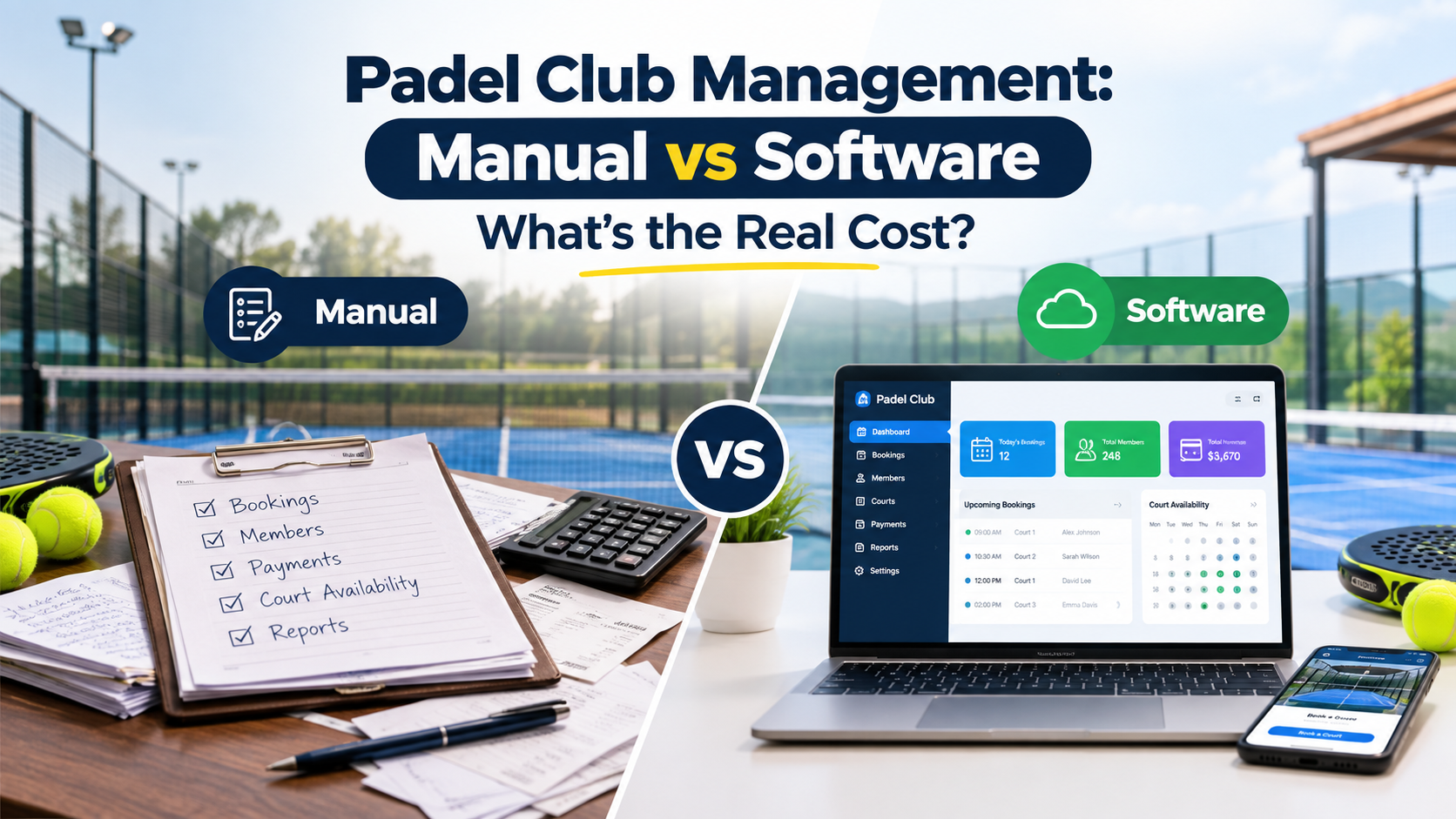
Ask any padel club owner how they are running their business and you will get one of two answers. Either they proudly say, “we’ve got a system for that,” or they laugh a little awkwardly and admit it’s mostly WhatsApp groups, a shared spreadsheet, and a whiteboard that somebody keeps forgetting to update. Honestly, both camps exist for a reason. When padel was a niche sport with two courts and a handful of regulars, a notebook and a calm mind were enough.
But padel has grown fast and grown messy in places. Clubs that started with two courts now run eight. Managers who used to know every player by name are now juggling hundreds of members, coaches, tournaments, and a phone that never stops buzzing. At some point, the “just wing it” approach stops being charming and starts costing real money. The tricky part is that this cost is often invisible. Nobody sends you an invoice for a missed booking or a member who quietly left because reserving a court felt like a hassle.
What “Manual Management” Actually Involves?
Manual management can look deceptively simple at first. A few courts, a phone, a spreadsheet, maybe a group chat for bookings, and someone at the front desk. That setup can work fine when things are small and steady.
The trouble starts once all these separate pieces have to work together. A player messages to book a court. Someone has to check if it’s free, confirm the slot, note it down, collect payment, and update the schedule. If that player cancels later, all of that has to be undone and communicated again. Multiply that by dozens of players and several courts, and it adds up quickly.
The typical manual setup usually includes some combination of:
- A shared spreadsheet or calendar for court bookings.
- A group chat where players ask about availability or cancel plans.
- Cash or bank transfers for payments, tracked by hand.
- Paper or spreadsheet records for memberships and coaching schedules.
- Someone, usually the owner, following up on unpaid dues.
Bookings and Scheduling Get Complicated Fast: When everything lives in a spreadsheet, calendar, or messaging app, keeping one accurate view of what’s actually available becomes harder as the club grows. It’s not just about noting down a booking. Staff also have to juggle peak and off-peak hours, recurring reservations, cancellations, membership perks, different pricing, coaching sessions, and events, often all at once. This gets especially messy when more than one person is handling bookings, since it’s easy for two people to accidentally offer the same slot to different players.
Payments and Outstanding Dues Pile Up: Someone also has to track who has paid and who hasn’t. That usually means checking bank transfers, cash payments, and the odd payment screenshot, all kept separately instead of in one clear place. It’s easy for a few unpaid bookings to slip through unnoticed until someone finally sits down to reconcile everything.
Player Records Get Harder to Manage as the Club Grows: A growing club isn’t just managing courts, it’s managing people. Booking history, membership details, preferences, and payment records all pile up over time. Keeping this information updated across scattered tools becomes more complicated the moment a club starts offering memberships, classes, or promotions.
Communication Turns into a Job of Its Own: Manual management can quietly turn communication into a huge part of the daily workload. Booking confirmations, cancellation notices, payment reminders, and schedule changes all must be sent out, often one message at a time. None of this shows up as a single cost on paper, but it adds up in hours spent every single day.
The No-Show Problem: Cancellations and no-shows are another common headache. Without any kind of reminder system or upfront payment in place, players are more likely to simply not show up. Every no-show means a court sat empty when someone else could have booked it.
Tournament Chaos: Tournaments tend to be the most chaotic part of manual management. Paper brackets, manual scoring, and pairings that don’t quite balance out are common, simply because there’s no easy way to organize the data otherwise.
The Hidden Time Cost: Perhaps the biggest cost of all is time. Owners running things manually often end up spending several hours a week just recording payments and following up with people who owe money. That’s a meaningful chunk of the week spent on something that, in a more organized setup, could largely take care of itself.
What “Software Management” Actually Involves?
Moving away from manual management doesn’t mean adding more complexity, it usually means the opposite. Instead of chasing information across spreadsheets and chats, everything lives in one place, and the system does a lot of the routine work that used to fall on staff.
Solving the Double-Booking Problem: When bookings update in real time through a real-time court booking system, the same slot can’t accidentally be given to two different players.
Payments That Actually Get Collected: When a booking requires payment upfront, a reservation actually means something. Clubs that shift to this approach tend to recover a meaningful amount of the income that used to disappear through no-shows and unpaid bookings.
Real Visibility into Court Usage: Instead of guessing which hours are busy or quiet, a proper system can show it clearly. That kind of visibility lets a club notice patterns, like a consistently empty weekday morning, and actually do something about it, rather than just accepting it as normal.
Booking Becomes a Direct Process: Instead of a player messaging staff who then have to check and confirm availability, players can simply see what’s open and book it themselves. It sounds like a small change, but at a busy club, it removes a lot of repeated back-and-forth.
Tournaments and Events Get Easier to Run: With everything organized in one system, brackets, scoring, and player pairings can be handled with far less manual effort, freeing up time that would otherwise go into paperwork during a club’s busiest events.
Hours Given Back to the Team: Perhaps the biggest shift is time. Staff and managers tend to get a noticeable chunk of their week back once repetitive tasks like scheduling, reminders, and payment tracking stop needing constant manual attention.
The Real Cost Comparison
The idea that manual management is “free” tends to fall apart once you actually think it through. It doesn’t cost money in a subscription sense, sure, but it costs money in lost bookings, wasted hours, and slower growth.
A club running manually can lose a meaningful share of its potential income simply because bookings, cancellations, and payments aren’t tightly managed. On the other side, a more organized system usually comes with a predictable monthly cost that’s a small fraction of what inefficiency quietly costs over time.
Factors Affecting Cost
| Factor | Manual Management | Organized System |
| Monthly cost | No direct fee, but hidden losses | A predictable, ongoing cost |
| No-show rate | Noticeably higher without reminders or upfront payment | Meaningfully lower with reminders and prepayment |
| Admin time spent weekly | A significant chunk of the week | Substantially reduced |
| Double bookings | Common, especially with informal scheduling | Rare, thanks to real-time updates |
| Revenue lost to inefficiency | A meaningful share of potential income | Largely recovered |
| Tournament management | Manual brackets and scoring | Organized and far less time-consuming |
| Occupancy visibility | Guesswork based on memory | Clear and data-driven |
ROI: When Software Pays for Itself
This is what every owner really wants to know. Is it worth it, or just another expense? For most growing clubs, it tends to pay for itself fairly quickly. If a club is losing even a modest share of potential revenue to inefficiency, that adds up to real money walking out the door every month. A predictable monthly cost is usually a small fraction of that ongoing loss.
Add in the time saved. If a manager or staff member is spending several hours a week on manual collections and scheduling, and that drops close to zero, that time can go into things that actually grow the club, like member retention or coaching quality, instead of just keeping the lights on.
A Practical Way to Think It Through
Before deciding either way, it helps to honestly track a few things for a couple of weeks:
- How many hours do staff spend managing bookings each week?
- How many booking enquiries come in outside normal hours?
- How many cancellations need manual handling?
- How much time goes into figuring out who has and hasn’t paid?
- How many court slots sit empty that could have been filled?
- How many membership renewals need manual follow-up?
Comparing those real, everyday costs against what an organized system would cost gives a much more honest answer than just comparing sticker prices.
When Manual Might Still Make Sense
Manual management isn’t always the wrong choice. If a club has just one or two courts, a small and steady group of regulars, and rarely deals with last-minute cancellations, a spreadsheet and a group chat might genuinely be enough. Learning a new system, moving over old records, and training staff takes effort, and that effort isn’t always worth it for a very small, stable setup.
It can also make sense for a club that’s still finding its feet. If you have just opened and aren’t sure yet how demand will look, it’s reasonable to wait until you understand your booking patterns better before committing to anything more formal.
The real deciding factor is scale. Manual works fine when the number of moving parts is small enough to hold in your head. The moment that stops being true, the math tends to flip pretty quickly.
Signs Your Club Has Outgrown Manual Management
There’s rarely one clear moment where a club suddenly becomes “too big” for spreadsheets and group chats. The signs tend to show up gradually.
- Double bookings are becoming a regular headache, not a rare mistake.
- You are spending real chunks of the week chasing payments.
- Your phone doesn’t stop ringing with people asking about availability.
- Tournaments feel like chaos to organize rather than an event to look forward to.
- You genuinely can’t say which hours are your busiest or quietest.
- You have started adding memberships, coaching, or events, and keeping track of it all is getting harder.
If more than one or two of these sound familiar, it’s probably a sign that the club has outgrown its current setup.
What to Look for in Padel Club Management Software
Not every system needs to do everything. The better approach is to start with the actual problems your club is facing.
- Real-time booking that updates instantly, so double bookings stop happening.
- Prepayment and reminders to bring no-show rates down.
- Membership and billing tools if your club relies on recurring memberships rather than one-off bookings.
- Reporting and visibility into occupancy, so pricing and staffing decisions are based on real data instead of guesswork.
- Tournament and event tools if these are a regular part of your calendar.
- Clear, transparent pricing, so you know exactly what you are paying for as the club grows, not just the advertised monthly number.
Conclusion
The honest truth is that manual management isn’t free, it just hides its cost in places that are easy to overlook. Missed bookings, chasing payments, and empty court hours nobody noticed all add up quietly in the background. A more organized system doesn’t remove every challenge of running a padel club, but it does turn invisible losses into something clear and manageable, and for most clubs beyond a very small scale, that trade tends to be worth it.
If spreadsheets and group chats are still working fine for you, there’s no rush to change anything. But if double bookings, unpaid dues, and unclear busy hours are becoming a regular part of your week, that’s usually the moment things start to tip in favour of a more organized approach.
Your questions, our answers
Yes. Manual management can work well for a small club with only a few courts, a limited number of regular players, and relatively simple booking and payment processes. The need for software usually becomes more apparent as bookings, memberships, coaching, events, and administrative tasks increase.
Time is often the biggest hidden cost. Staff may spend hours handling booking requests, updating schedules, checking payments, sending reminders, managing cancellations, and preparing reports. These tasks may not appear as separate expenses, but they still have an operational cost.
Yes. A centralised booking system with real-time availability can reduce the risk of two staff members assigning the same court and time slot to different players. It also gives staff and players a clearer view of available courts.
Depending on the platform, clubs can use advance payment requirements, automated booking confirmations, reminders, and cancellation policies. These measures can make bookings more accountable and give the club an opportunity to manage cancellations before a court is left unused.
Yes. Many management platforms provide booking and utilisation data that can help clubs understand which courts and time periods are most or least used. This can help managers make more informed decisions about scheduling, promotions, coaching sessions, and other activities.
There is no fixed number of courts or members that makes the switch necessary. A better indicator is operational pressure. Frequent double bookings, increasing payment follow-ups, constant booking enquiries, difficulty managing memberships, and poor visibility into court usage are all signs that the existing system may no longer be sufficient.
It depends on the club's size, booking volume, staffing costs, and operational needs. The most useful comparison is not simply the software subscription against zero cost. Clubs should also consider the staff time, missed bookings, payment follow-ups, empty court slots, and administrative work associated with their current manual system.
The right features depend on how the club operates. However, online court booking, real-time availability, payment management, memberships, reporting, reminders, and tournament or event management can be particularly useful for clubs that are growing beyond a simple booking setup.