Picture this. A local bakery owner searches for a way to get found online. She finds a directory, adds her listing, and two weeks later she gets a call from a customer who says, “I found you on that site.” That tiny moment is why directories still matter.
Building one is a real project, though, and a lot of people quit halfway. So let’s walk through it step by step, the way you’d explain it to a friend over coffee.
Why can a directory still work?
A directory organizes information about businesses, services, or products into categories. Listings usually include names, contact details, descriptions, and sometimes reviews. As more listings get added, the site becomes more valuable to both users and advertisers, which makes earning easier.
That growth loop is the whole game. More listings attract more visitors. More visitors attract more businesses. Then the revenue follows.
There is one catch. Strong data structure and useful listings need to come before monetization. So, build value first and think about money second.
How to Build a Business Directory Website?
Step 1: Pick a niche you can actually own
Trying to list “everything for everyone” is a fast way to burn out. One popular guide breaks the process into six parts: find the right niche, build the database, encourage reviews, boost visibility, monetize, and improve conversion rates. Notice that the niche comes first.
A niche might be a city, an industry, or a specific audience. Think “pet-friendly cafes in one region” instead of “all restaurants.” Smaller focus means less competition and a more loyal audience.
Ask yourself three quick questions:
- Do people already search for this kind of information?
- Can I collect accurate data without going crazy?
- Would businesses in this space pay to stand out?
If you can say yes to all three, you are on the right track.
Step 2: Build a database people can trust
An empty directory is a sad directory. Nobody wants to visit a site with three listings. You will need a proper database before launch, and one guide notes you can fill it using business listings and public records.
Here is the part many beginners miss. Listing owners should feel in control. Give business owners the ability to claim and manage their own listing. That builds trust, keeps information fresh, and gives you a natural path to upsell later.
Accuracy matters more than volume. Wrong phone numbers and closed shops make visitors leave and never return. Also, NAP stands for Name, Address, and Phone, and these details are critical for local SEO. Keep them consistent everywhere.
Step 3: Choose your platform and tools
You don’t need to code everything from scratch. Ready-made business directory software like Shine Directory gives you custom fields, search filters, owner dashboards and payments out of the box. Whichever platform you pick, check for these features:
- Custom fields for hours, location, and categories
- Search and filter tools that feel fast
- A way for owners to submit and edit listings
- Payment support for paid plans
- Room to grow as your data grows
Handling data properly is key to smooth performance and a good experience, especially as your directory grows. Plan for that early, because migrating later is painful.
Step 4: Design for the person who is in a hurry
Most visitors are trying to solve a problem right now. They want a plumber, a dentist, or a wedding venue. Make that path short.
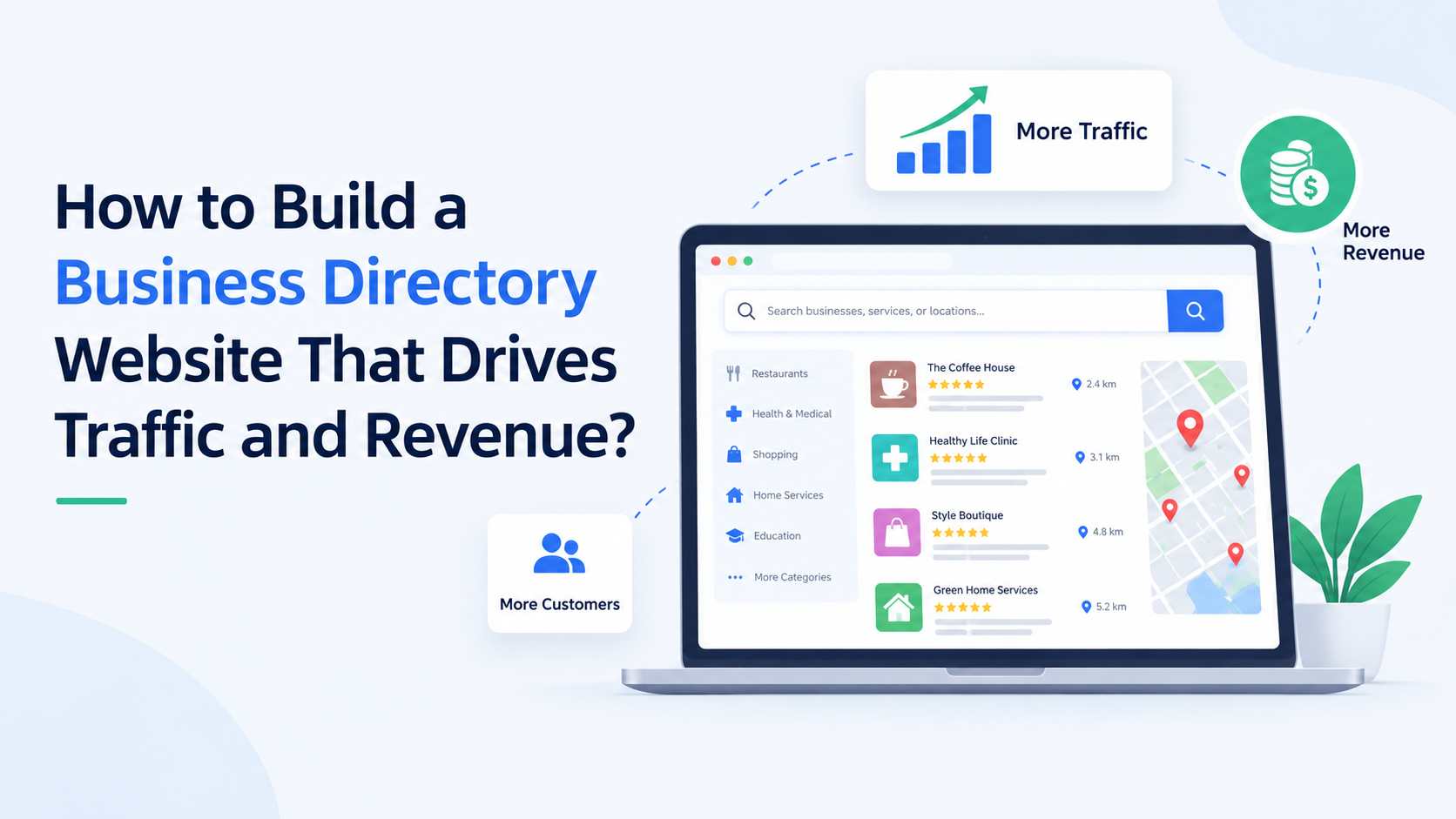
Keep your homepage simple: Put a strong search bar up top. Show clear categories. Use photos and readable listing pages.
Speed matters too: Google recommends good Core Web Vitals, and it lists three targets:
- Largest Contentful Paint within 2.5 seconds.
- Interaction to Next Paint under 200 milliseconds.
- Cumulative Layout Shift under 0.1.
Slow, jumpy pages frustrate people, and frustrated people leave.
Step 5: Do SEO the smart way
Traffic is the fuel. Without it, no revenue plan works. Directory owners can attract search traffic with local or global SEO, track results with Google Analytics, and add social media and affiliate marketing.
Here are the factors that matter most.
Create local landing pages: If your directory covers several cities or regions, build a separate landing page for each area, since local SEO is a powerful traffic driver. Make each page genuinely useful, though. More on that in a moment.
Target long-tail keywords: Use specific phrases in your landing pages and blog, such as “best local business directory in [city]” or “top hotel listings in [region].” Specific searches are easier to win and often come from people ready to act.
Add structured data: LocalBusiness markup helps Google understand your listings. It can describe business hours, departments, and reviews if your site captures reviews about other businesses. Google recommends using the most specific subtype that fits. Keep in mind that Google does not guarantee rich results will appear. Test your pages with the URL Inspection tool.
Write helpful content: Guides, city roundups, and “how to choose” articles bring in visitors who aren’t ready to search a category yet. They also give your directory a personality.
Step 6: Avoid the thin content trap
This is where directories get hurt. It’s tempting to generate hundreds of near-identical pages fast. Don’t.
Google describes scaled content abuse as generating many pages mainly to manipulate rankings instead of helping users. Volume alone isn’t the problem. Empty pages built only to rank are.
Ask yourself before publishing any page; would a real person find this useful? If the answer is no, improve it or leave it out.
Affiliate links come with a similar warning. Thin affiliation means copying product descriptions and reviews from a merchant without adding anything original. Good affiliate pages add value through things like extra information, original reviews, ratings, and helpful comparisons.
Step 7: Make reviews work for you
Reviews are the trust engine: BrightLocal’s 2026 survey found that 91% of consumers read reviews for local businesses, and the average person uses six different review sites. People compare before they choose.
The standards are climbing too: The same survey found that 47% of consumers won’t consider a business with fewer than 20 reviews. And 85% are more likely to use a business after reading positive reviews.
Owner replies matter as well: In BrightLocal’s 2024 edition, 88% of consumers said they’d use a business that replies to all its reviews, compared with just 47% for businesses that don’t respond at all. So build a review feature into your directory, and let owners respond. It makes your listings feel alive.
Step 8: Turn traffic into revenue
Now for the part as everyone asks about; Directory sites generally earn from three main sources, and popular models include freemium, paid listings, affiliate marketing, and lead generation.
Paid and featured listings: Offer a free basic listing, then charge for upgrades like top placement, extra photos, or a highlighted badge.
Memberships: A subscription model for listings, similar to a newspaper or magazine, gives you recurring income. Predictable income is easier to plan around.
Advertising: Once your directory grows, you can show targeted ads, sell ad space, or add affiliate links.
Lead generation: You send interested customers straight to businesses and charge for those leads.
Local SEO services: If premium listings are a hard sell at first, you can consider selling NAP citation submissions for local SEO.
How do you convince a business to pay? Show them the value. Offer incentives such as promotional packages, detailed analytics, and SEO benefits, and share stats on how already-listed businesses are progressing. Real numbers beat big promises every time.
One more selling point is worth knowing. Listings on other sites can help a business’s SEO, since Google considers how many links point to a site. Be honest about this benefit and don’t overpromise.
A simple launch checklist
- Choose a focused niche
- Collect accurate listings and check them
- Pick a platform that can scale
- Design a fast, clean search experience
- Add LocalBusiness structured data
- Build helpful local landing pages
- Turn on reviews and owner replies
- Start with a free tier, then add paid options
- Track results and improve
Final thoughts
Building a directory isn’t a get-rich-quick trick. It’s slow, and sometimes it feels like nothing is happening. Then one day a business owner emails you to say a customer found them through your site. That’s when it clicks.
Success comes from careful planning, ongoing optimization, and real value for both businesses and users. Start small, stay useful, and keep improving. The traffic and revenue tend to follow.
Your questions, our answers
Start by choosing a focused niche, collecting accurate business listings, selecting a suitable platform, and creating a simple search and category structure.
Common revenue models include paid and featured listings, memberships, advertising, affiliate marketing, lead generation, and local SEO services.
Offer free basic listings initially, make the claiming process easy, and give businesses useful reasons to upgrade, such as featured placement, analytics, additional listing features, or promotional opportunities.
Focus on local SEO, useful landing pages, long-tail keywords, structured data, helpful content, social media, and a fast user experience.
Reviews can help visitors evaluate businesses and make directory listings more useful. Allowing business owners to respond can also keep listings active and informative.
A useful listing can include the business name, address, phone number, website, category, description, opening hours, photos, reviews, and other relevant details.
There is no fixed timeline. Growth depends on factors such as niche demand, listing quality, SEO, user experience, marketing, and how consistently the directory is maintained.