
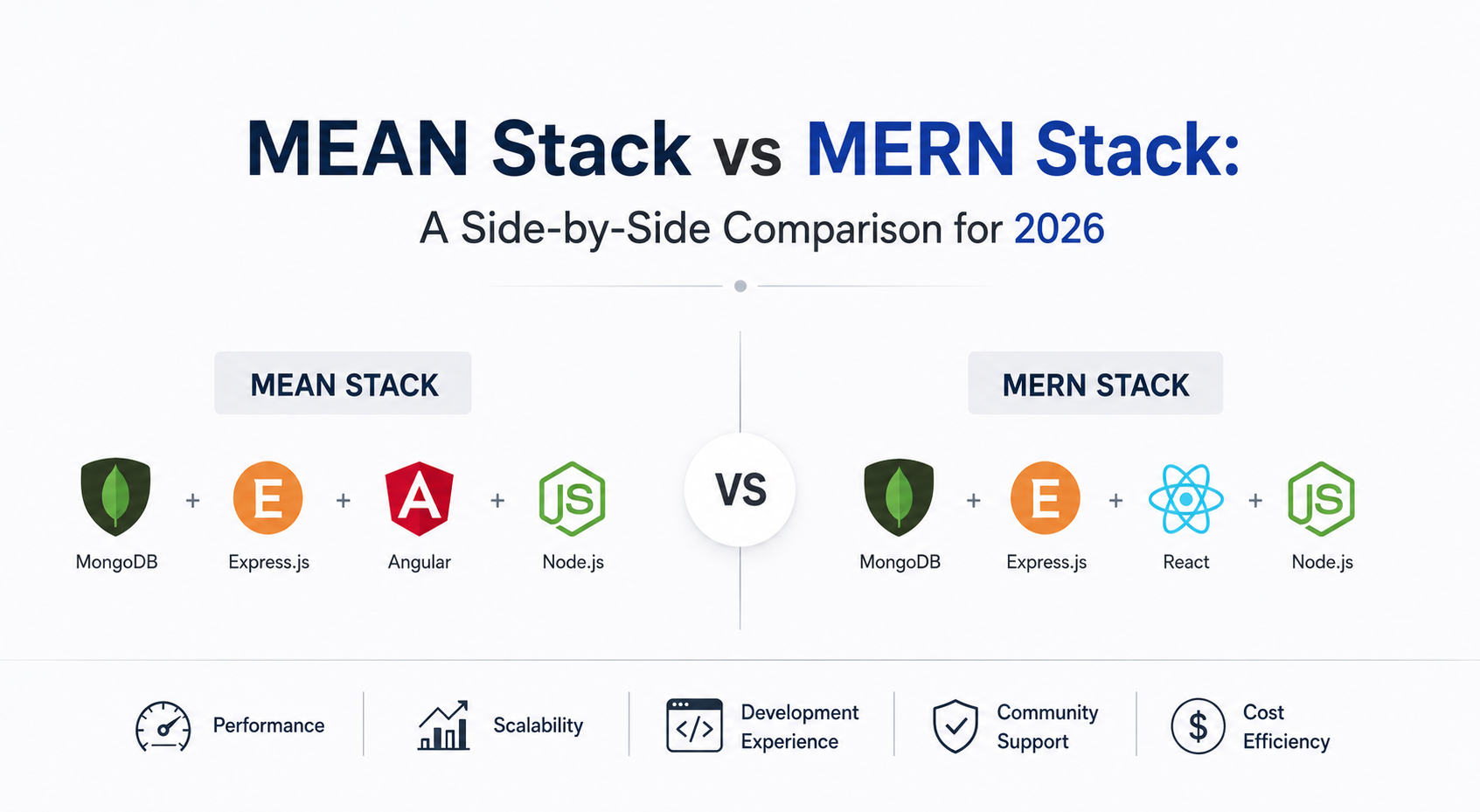
If you have spent any time browsing developer forums, you have probably run into the MEAN vs MERN debate more than once. It’s one of those comparisons that never quite goes away, mostly because both stacks keep evolving instead of fading out. And honestly, that’s a good thing for anyone trying to decide where to invest their learning time in 2026.
Here’s the short version before we go deep: MEAN and MERN share three of their four letters. MongoDB, Express.js, and Node.js appear in both. The real difference comes down to the front end, Angular in MEAN, React in MERN. That single swap changes how you structure your code, how steep your learning curve looks, and even what kind of job listings you will be a good fit for.
Key Takeaways
- MEAN and MERN both use MongoDB, Express.js, and Node.js.
- The main difference is the front-end technology: Angular in MEAN and React in MERN.
- MEAN offers a more structured and opinionated development approach.
- MERN provides greater flexibility and is generally easier for JavaScript beginners.
- MEAN is well suited for large, enterprise-level and long-term applications.
- MERN is a popular choice for startups, MVPs, dashboards, and highly interactive applications.
- React generally has a larger developer community and job market.
- Angular can be valuable for developers targeting enterprise and specialized roles.
- Neither stack is universally better; the right choice depends on the project’s requirements, team, and long-term goals.
- Since both stacks share most of their technologies, switching between MEAN and MERN is relatively straightforward.
What Is the MEAN Stack?
MEAN is a JavaScript-based framework built around four technologies: MongoDB, Express.js, Angular, and Node.js. As MongoDB’s own resource page puts it, these four layers work together to build scalable, dynamic web applications, and every piece of the stack is open source.
MongoDB: A NoSQL, document-oriented database that stores data in a flexible, JSON-like format instead of rigid tables, which makes it a natural fit for JavaScript applications.
Express.js: A lightweight web application framework that runs on top of Node.js and handles routing along with the back-and-forth between the front end and the database.
Angular: Google’s front-end framework, used to build dynamic, component-based single-page applications with two-way data binding and dependency injection baked in.
Node.js: A runtime environment that lets you execute JavaScript on the server, using Google’s V8 engine to handle scalable, event-driven applications.
Because the front end and back end both run-on JavaScript, there’s no need to translate objects as they move between the application and the database, everything just passes through as JSON.
What Is the MERN Stack?
MERN swaps out just one piece of the puzzle. It stands for MongoDB, Express, React, and Node. According to MongoDB’s own documentation, MERN is essentially a variation of MEAN, where Angular is replaced by React on the front end. (There’s also MEVN, which swaps in Vue.js, but that’s a separate conversation.)
MongoDB: Same document database as MEAN, storing data in flexible, JSON-like documents rather than SQL tables.
Express: The same minimalist back-end framework, again running on Node.js.
React: Meta’s JavaScript library for building user interfaces through reusable, component-based pieces, widely known for its virtual DOM approach to rendering.
Node.js: The same JavaScript runtime environment that powers the server side of the application.
So really, the two stacks aren’t rivals in the dramatic sense people sometimes make them out to be. They are siblings that took different paths on the front end, and that one decision ripples outward into everything else.
MEAN vs MERN: Head-to-Head Comparison
| Factor | MEAN Stack | MERN Stack |
| Front-end tech | Angular (TypeScript-based, full framework) | React (JavaScript library, component-based) |
| Learning curve | Steeper, TypeScript, modules, decorators, dependency injection | Gentler, focuses mainly on the UI layer, easier for JS beginners |
| Architecture style | Opinionated, structured, batteries-included | Flexible, you assemble your own tooling around it |
| Rendering approach | Real DOM with optimized change detection | Virtual DOM, often praised for fast UI updates |
| Best suited for | Large enterprise apps, regulated industries, long-term projects | Startups, MVPs, highly interactive single-page apps |
| Developer adoption | Angular: 18.2% of developers surveyed | React: 44.7% of developers surveyed |
| Job market | Fewer listings, but also less competition per role | Roughly 2x more open positions in most markets |
Features: MEAN Vs. MERN
Learning Curve
This is usually the first thing people ask about, and for good reason, it shapes how quickly you can start shipping. React tends to be the easier on-ramp because it focuses narrowly on the view layer, so once you know JavaScript basics, you can get productive fairly fast. Angular, on the other hand, comes with more moving parts right out of the gate: TypeScript, decorators, modules, and dependency injection all need to click before things start feeling natural. That said, once Angular clicks, it tends to click hard, a lot of developers who’ve worked with both frameworks say Angular’s structure pays off on bigger, longer-running codebases where consistency matters more than speed of ramp-up.
Performance and Rendering
React’s virtual DOM is often cited as giving it an edge in UI rendering speed, particularly for apps with a lot of dynamic, frequently changing content. Angular uses the real DOM but compensates with an optimized change-detection system, and it holds up well for complex enterprise applications where structure matters more than raw rendering speed. Neither one is objectively “faster” across the board, it really comes down to what kind of app you are building and how it’s architected.
Architecture and Flexibility
Angular is what you’d call an opinionated framework, it hands you routing, forms, HTTP handling, and more, all built in, which reduces the number of decisions your team has to make up front. React takes the opposite approach: it gives you the UI layer and lets you pick your own router, state manager, and everything else. That flexibility is a double-edged sword. It’s genuinely powerful when your team knows what it’s doing, but it also means the “right” set of libraries can shift every couple of years, sometimes forcing older React projects into fairly involved dependency migrations.
Job Market and Salary
React clearly wins on volume. Job board data from mid-2026 shows roughly two to three times more open React roles than Angular roles in the US, and that gap holds up globally too, though Angular stays notably stronger in European enterprise markets, Germany in particular, along with government and defence contracting. Salary numbers vary quite a bit depending on the source, but several point to a modest premium for Angular developers, generally attributed to a smaller, more specialized talent pool being pulled toward the same enterprise-level demand. In short: React gets you more options, Angular can mean less competition for each one.
Where Each Stack Tends to Show Up MEAN Common Use Cases Enterprise-grade web portals Banking and finance dashboards Healthcare and regulated systems Large internal business tools MERN Common Use Cases Startup MVPs and prototypes social platforms and dashboards Real-time apps (chat, games) Content-driven single-page apps.
Want to apply what you learn on real projects? Explore our Internship Program to build practical MERN/MEAN experience before entering the job market.
Which One Should You Actually Choose?
Honestly, there isn’t a universal winner here, and anyone who tells you otherwise is probably oversimplifying. It comes down to a few practical questions rather than a popularity contest.
If you are just starting out, or you are building something quick like a startup MVP, React’s shallower learning curve and larger community usually make MERN the more comfortable choice. You will find more tutorials, more Stack Overflow answers, and more developers to hire from if the project grows.
On the other hand, if you are working on a large, long-term enterprise system, especially one in a regulated industry like finance or healthcare, Angular’s built-in structure and strict conventions in MEAN can save you from a lot of architectural headaches down the road. It’s the kind of stack that rewards teams willing to invest more time up front in exchange for consistency later.
And here’s the part that often gets left out of these comparisons: switching between them isn’t as painful as switching languages entirely. Because both stacks share MongoDB, Express, and Node, developers moving from one to the other are really only relearning the front-end layer, not the whole system. So even the “wrong” first choice isn’t really a dead end.
If you’d rather learn both stacks hands-on with guided projects, check out our MEAN/MERN Stack Training in Chandigarh & Mohali.
Summarizing It
MEAN and MERN aren’t competing philosophies so much as two flavours of the same core idea, build everything in JavaScript, keep the stack consistent, and let MongoDB handle flexible, document-based data. MEAN leans structured and enterprise-friendly through Angular. MERN leans fast and flexible through React. Neither is going anywhere in 2026; both keep getting updated, both keep showing up in production at serious companies, and both are perfectly reasonable bets depending on what you are building.
If you are still torn, a decent rule of thumb: pick MERN if you want speed and a gentler ramp-up, pick MEAN if you are optimizing for long-term structure on a bigger team. Either way, you are building on solid, well-supported ground.