Imagine someone has a camera they rarely use, a spare room that stays empty, or a car parked for days. Meanwhile, someone else needs that exact thing but does not want to buy it. A rental marketplace connects these two people, allowing owners to earn money from underused assets while renters access what they need temporarily.
Rental marketplaces operate across industries such as real estate, transportation, equipment, fashion, and household products. But how do these platforms make money without owning the assets themselves? They earn through commissions, service fees, subscriptions, listing charges, and additional services.
This guide explains how rental marketplace business models work, their primary revenue streams, operating costs, and the steps required to build a sustainable platform.
What Is a Rental Marketplace Business Model?
A rental marketplace business model connects individuals or businesses offering assets for rent with customers who need temporary access to them. The platform provides a digital space where users can discover listings, compare prices, check availability, and book rentals. Depending on its services, it may also manage payments, verification, deposits, rental agreements, and disputes.
Unlike a traditional rental company, a marketplace generally does not need to purchase every asset. Owners provide the inventory, while the platform facilitates transactions and earns revenue for its services. For example, a camera rental marketplace allows owners to list equipment, renters to book cameras for specific periods, and the platform to collect a commission or service fee. Its value comes from making the process convenient, accessible, and trustworthy.
How Does a Rental Marketplace Work?
Most rental marketplaces follow a similar process:
- Owners create listings: They upload photographs, descriptions, rental prices, availability, and rental conditions.
- Renters search for options: Customers compare listings, check reviews, and select suitable products or properties.
- Customers make bookings: Renters choose their rental period, agree to the terms, and pay the amount due.
- The platform processes payments: Depending on its payment arrangement, the marketplace deducts applicable fees and transfers the remaining amount to the owner.
- The rental is completed: Customers use the asset for the agreed period and return it or check out according to the rental terms.
The platform earns money through the fees it collects during this process. However, the total booking value is not the same as its revenue. If a customer pays ₹5,000 for a rental, the marketplace earns only the portion it is entitled to retain.
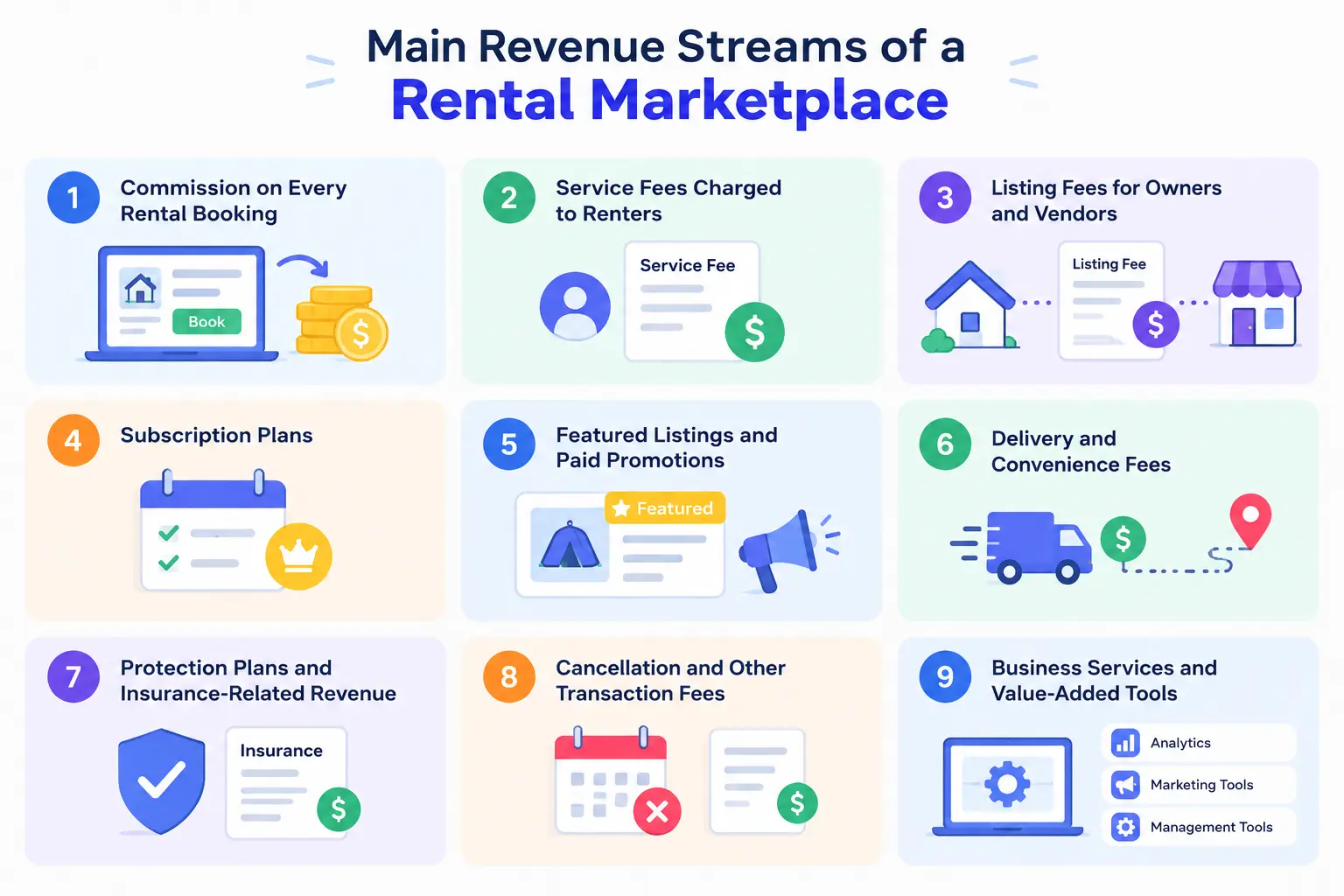
Main Revenue Streams of a Rental Marketplace
A rental marketplace can combine several revenue streams, depending on its audience, services, and operating costs.
1. Commission on Every Rental Booking
Commission-based revenue is one of the simplest ways to monetize a rental marketplace. The platform charges a percentage of each completed transaction and transfers the remaining amount to the owner, subject to other applicable deductions.
For example, if a customer rents equipment for ₹5,000 and the platform charges a hypothetical 10% commission, the marketplace earns ₹500 before expenses, while the owner receives ₹4,500 before other deductions.
This model aligns platform earnings with completed bookings. However, commissions should remain reasonable. Excessive charges may encourage owners to increase prices or arrange transactions outside the platform.
2. Service Fees Charged to Renters
A platform may charge renters an additional fee for services such as payment processing, booking management, customer support, and dispute resolution. The fee can be fixed, percentage-based, or dependent on the booking value. For example, a ₹2,000 rental might include a separate ₹100 service fee.
Transparency is essential. Customers should understand the complete price before confirming their bookings. Unexpected charges can lead to abandoned transactions and reduced trust.
3. Listing Fees for Owners and Vendors
Some marketplaces charge owners to publish or maintain listings. These charges can be structured as one-time payments, recurring fees, category-based charges, or premium listing options.
Listing fees can generate revenue even when a booking has not occurred. However, they may discourage new owners who are uncertain about demand. Offering free basic listings initially and introducing paid options after establishing demand can be a practical approach.
4. Subscription Plans
Subscriptions provide recurring revenue from frequent users, professional vendors, and rental businesses. Paid plans may include more active listings, advanced booking management, performance reports, team access, reduced transaction fees, or priority support.
For example, an equipment rental company managing dozens of items may pay for tools that simplify inventory management and booking schedules. Subscriptions can make revenue more predictable, but customers must receive ongoing value to justify recurring payments.
5. Featured Listings and Paid Promotions
As a marketplace attracts more visitors, owners may pay for additional visibility. Promotional options can include featured search results, highlighted category listings, sponsored placements, and seasonal promotions.
This model works best when the platform already attracts relevant traffic. Paid placements should remain clearly identifiable where appropriate and should not mislead customers.
6. Delivery and Convenience Fees
Some rentals require transportation, installation, pickup, cleaning, or collection. A marketplace can coordinate these services and charge an additional fee.
For instance, a platform might arrange furniture delivery or transport construction equipment to a job site. However, delivery revenue is not automatically profit. The platform must account for logistics providers, transportation, and other service costs.
7. Protection Plans and Insurance-Related Revenue
Renters and owners may worry about damaged, lost, or stolen items. A marketplace can facilitate eligible protection products or insurance through appropriate providers.
Depending on the arrangement, it may earn a disclosed service fee or referral revenue.
These offerings require clear coverage terms, exclusions, and responsibilities. A refundable security deposit is not automatically revenue, and insurance-related arrangements may be subject to local regulations.
8. Cancellation and Other Transaction Fees
Depending on its policies, a marketplace may charge for late returns, eligible cancellations, no-shows, or additional cleaning and damage costs.
These charges should follow clear rental agreements and applicable laws. They are better treated as transaction-related charges than as a dependable primary revenue stream.
9. Business Services and Value-Added Tools
Professional rental businesses may need inventory management, booking calendars, automated reminders, customer management, reporting, and software integrations.
A marketplace can offer these features as paid services. For example, an equipment rental company may use such tools to track availability, overdue returns, and revenue generated by individual items.
Different Types of Rental Marketplace Business Models
The marketplace structure determines who supplies the assets, who pays the fees, and what responsibilities the platform manages.
Peer-to-peer (P2P): Connects individual owners with renters. A peer-to-peer rental platform lets any user switch between being a renter and an owner. The platform can earn through commissions and service fees without purchasing the listed assets.
Business-to-consumer (B2C): Connects rental businesses with individual customers. Revenue may come from commissions, vendor subscriptions, and paid tools.
Business-to-business (B2B): Connects businesses needing temporary access to equipment or machinery with suppliers. Transactions may involve negotiated prices, longer rental periods, delivery, and contractual requirements.
Hybrid marketplace: Combines individuals and professional vendors. It can offer greater inventory variety but requires flexible pricing, listing policies, and booking workflows.
What Costs Does a Rental Marketplace Need to Cover?
Even without owning the assets, a marketplace requires investment to operate reliably.
Platform development and maintenance: Covers listings, search, booking calendars, payment integration, notifications, and administrative tools.
Marketing and customer acquisition: Includes advertising, search engine optimization, promotional campaigns, and vendor outreach.
Payment processing: Covers transaction processing and payouts, depending on the payment provider and arrangement.
Customer support: Includes assistance with cancellations, late returns, damaged items, refunds, and disputes.
Trust, safety, and compliance: May involve identity checks, fraud prevention, privacy safeguards, insurance arrangements, and legal requirements.
Separating fixed operating expenses from transaction-related costs helps founders understand whether additional bookings improve profitability.
How Does a Rental Marketplace Make Money? An Example
Consider a hypothetical photography equipment marketplace where a customer books a camera for ₹4,000. The platform charges the owner a 10% commission and the renter a separate ₹100 service fee.
| Transaction detail | Amount |
| Rental price | ₹4,000 |
| Platform commission | ₹400 |
| Renter service fee | ₹100 |
| Platform’s gross fee revenue | ₹500 |
| Owner’s payout before other deductions | ₹3,600 |
| Total paid by renter | ₹4,100 |
The platform earns ₹500 in gross fee revenue from the booking, not ₹4,100. Payment processing, refunds, marketing, support, and other expenses affect how much it ultimately retains.
If it completes 500 identical bookings in a month, its gross fee revenue would be ₹2,50,000, assuming the same transaction value and fee structure throughout.
These figures are illustrative, not industry averages. Gross fee revenue should never be confused with net profit.
Key Metrics to Measure Marketplace Performance
Tracking the right metrics helps founders understand whether the platform is generating meaningful business value.
| Metric | What it measures |
| Gross merchandise value (GMV) | Total value of rentals booked through the platform |
| Net revenue | Revenue recognized under the platform’s accounting rules |
| Take rate | Marketplace revenue as a proportion of the defined GMV |
| Booking conversion rate | Percentage of relevant visitors or attempts resulting in bookings |
| Customer acquisition cost (CAC) | Cost of acquiring a customer |
| Repeat booking rate | How frequently customers return |
| Listing utilization | How effectively listed assets are rented |
| Cancellation rate | Proportion of bookings cancelled |
| Contribution margin | Revenue remaining after included variable costs |
Listing utilization is especially useful because owners need consistent demand to justify keeping their assets available. Similarly, high GMV does not guarantee profitability if transaction and operating expenses consume the revenue.
How to Build a Sustainable Rental Marketplace Business Model
Step 1: Choose a Specific Rental Niche
Focus on a defined category, such as furniture, cameras, vehicles, tools, or event equipment. Research rental frequency, customer expectations, pricing, and existing problems before expanding into multiple categories.
Step 2: Validate Demand
Speak with potential owners and renters before investing heavily. Test whether owners are willing to list assets, customers are willing to book, and the proposed fees are acceptable.
Step 3: Balance Supply and Demand
Recruit relevant owners and build sufficient inventory before promoting the platform widely. Concentrating on one category or location can help create a stronger initial marketplace.
Step 4: Select the Right Revenue Model
Choose a primary revenue stream based on the value the platform provides. Commissions may suit transaction-led platforms, while subscriptions can benefit professional vendors who need ongoing business tools.
Step 5: Make Trust a Priority
Provide accurate listings, clear rental agreements, reliable payment handling, appropriate verification, and accessible dispute resolution. Users should understand deposit policies, damage responsibilities, and refund conditions.
Step 6: Monitor Unit Economics
Calculate revenue per booking alongside payment costs, acquisition expenses, customer support, and other variable costs. If each booking costs more to support than it generates, increasing transaction volume alone will not solve the problem.
Common Challenges in the Rental Marketplace Business Model
Rental marketplaces face several challenges that can affect growth and profitability:
- Balancing supply and demand: Renters need enough suitable listings, while owners need regular bookings.
- Building trust: Verification, clear rental conditions, and dispute resolution reduce uncertainty.
- Preventing off-platform transactions: Convenient bookings, payment records, and reliable support give users reasons to remain on the platform.
- Managing damage and liability: Clear policies are essential for deposits, claims, refunds, and protection arrangements.
- Maintaining healthy margins: High booking volume is not enough if operating expenses consume the revenue.
- Expanding too quickly: Entering too many markets before validating demand can stretch resources.
Conclusion
A rental marketplace connects asset owners with customers who need temporary access to products or properties. Its revenue comes from facilitating these transactions and providing services that make renting more convenient and reliable.
Building a sustainable platform requires more than collecting commissions. Founders must balance supply and demand, maintain customer trust, manage costs, and understand the financial performance of each booking.
The most practical approach is to begin with a specific rental niche, validate demand, select a suitable revenue model, and expand only when the business demonstrates sustainable performance. Ultimately, a successful rental marketplace gives owners a reason to keep listing, renters a reason to return, and both sides a reason to trust the platform.
Your questions, our answers
It can earn through commissions, renter service fees, listing charges, subscriptions, featured listings, delivery coordination, and additional business services.
No. In a typical third-party marketplace, owners supply the assets while the platform facilitates bookings and transactions.
There is no universal answer. Commission-based revenue can suit transaction-led platforms, while subscriptions and paid business tools may work better for frequent users and professional vendors.
The rate depends on transaction value, operating expenses, market expectations, and the services provided. Founders should test pricing and evaluate the remaining margin.
GMV measures the total value of transactions, while revenue represents the income recognized by the platform. For example, a 10% take rate on ₹10 lakh in eligible bookings corresponds to ₹1 lakh in fee revenue, subject to the defined fee structure.
Start with a specific rental category, recruit relevant owners, provide accurate listings, and promote the platform to customers with a clear rental need. Transparent pricing and reliable support can encourage repeat bookings.
Yes. Monthly or annual subscriptions, inventory management tools, analytics, and premium vendor services can provide recurring income.