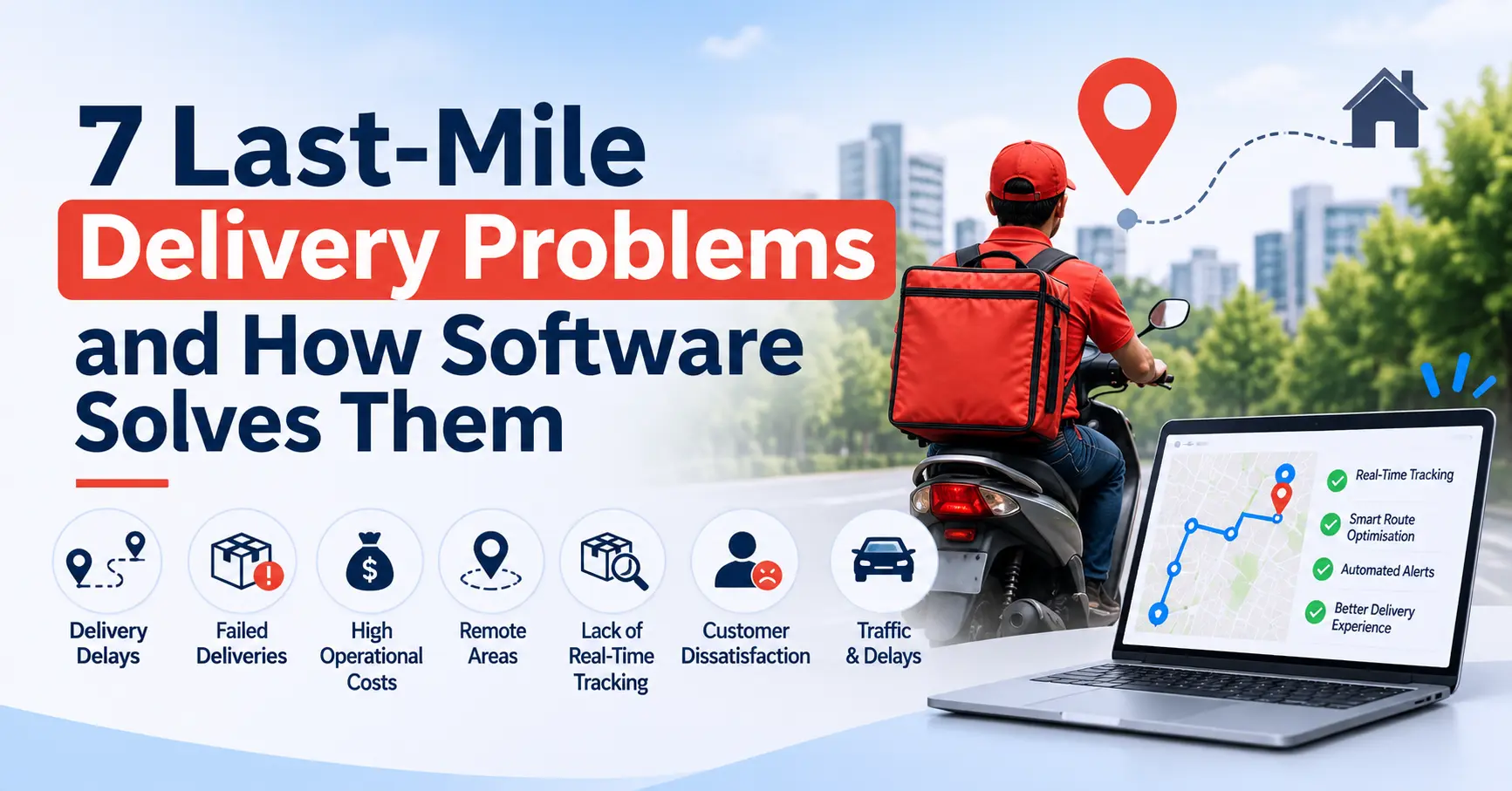
Last-mile delivery is often the most challenging stage of the delivery process. While a product may travel thousands of kilometres without major issues, getting it from a local distribution centre to the customer’s doorstep can be surprisingly complicated.
Traffic congestion, incorrect addresses, unavailable customers, and poor coordination can turn simple deliveries into operational challenges. When these issues occur across hundreds of orders, they increase costs and affect customer satisfaction. This is where technology helps. Last-mile delivery software supports route planning, shipment tracking, driver coordination, and customer communication.
What Is Last-Mile Delivery?
Last-mile delivery refers to the final stage of the logistics process, where a shipment moves from a distribution centre, warehouse, or local hub to its final destination. It is the stage where businesses directly interact with customers through the delivery experience.
For example, when someone orders groceries, electronics, or clothing online, the product usually moves through several stages before reaching the customer. Once it arrives at a nearby delivery facility, the final transportation to the customer’s address is known as last-mile delivery.
Although it is the shortest part of the supply chain in terms of distance, it involves several operational activities, including:
- Assigning orders to delivery personnel.
- Planning delivery routes and schedules.
- Coordinating vehicles and available delivery capacity.
- Managing customer availability and delivery preferences.
- Recording successful and unsuccessful delivery attempts.
- Handling returns and undelivered packages.
A small issue at any of these stages can affect the entire delivery experience. Therefore, businesses need a well-connected system to manage these activities.
Common Last-Mile Delivery Problems and Their Solutions
1. Inefficient Route Planning and Traffic Congestion
One of the biggest problems in last-mile delivery is finding the most efficient way to reach multiple delivery locations. A delivery executive might have 20 or 30 packages to deliver across different neighbourhoods. However, if the delivery sequence is not planned properly, they may end up travelling the same road multiple times, covering unnecessary distances, or reaching locations in an inconvenient order.
Traffic makes the situation even more complicated. A route that takes 15 minutes during the morning might take considerably longer during evening rush hours. Road closures, construction work, parking restrictions, and weather conditions can also affect delivery schedules.
How Software Solves It
Route optimisation software helps delivery businesses plan routes using information such as delivery addresses, vehicle capacity, delivery time windows, and road conditions.
Instead of assigning stops randomly, the system can calculate a more efficient sequence for completing deliveries. Here is how it helps:
- Automated Route Planning: The software organises multiple delivery stops into practical routes, reducing unnecessary travel.
- Traffic-Aware Routing: Where live traffic data is available, the system can help drivers avoid congested roads and identify alternative routes.
- Multi-Stop Optimisation: It considers several delivery locations together instead of treating every order as an independent journey.
- Dynamic Route Adjustments: If a road becomes inaccessible or a new delivery needs attention, routes can be recalculated.
For businesses managing large delivery fleets, this makes route planning less dependent on manual decisions. It also helps managers distribute workloads more effectively.
However, route optimisation does not eliminate traffic or guarantee a particular delivery time. Its value lies in helping businesses make better routing decisions with the information available.
Route optimisation software helps delivery businesses plan routes using information such as delivery addresses, vehicle capacity, delivery time windows, and road conditions.
2. Incorrect Addresses and Difficult Location Identification
An incorrect or incomplete delivery address can turn a straightforward delivery into a frustrating experience. This problem is particularly noticeable in locations where addresses are not always structured in a standard format. A customer might provide a building name without a street number, mention a nearby landmark, or forget to include an apartment or floor number.
For example, an address such as “near the main market, opposite the old bank” might make sense to someone familiar with the neighbourhood. However, a delivery executive visiting that area for the first time may struggle to identify the exact location.
In India, this challenge can become more complicated in smaller towns and developing residential areas, where street names and building identifiers may not always provide enough information for accurate navigation.
How Software Solves It
Address management and validation tools help businesses identify missing information and improve location accuracy before a shipment reaches the delivery stage. Some useful capabilities include:
- Address Validation: Checks whether the entered address contains the necessary information and flags possible errors.
- Geocoding: Converts written addresses into geographical coordinates that can be used for navigation.
- Location Pins: Allows customers to share an exact map location instead of depending entirely on written directions.
- Delivery Instructions: Stores additional details such as apartment numbers, gate information, landmarks, and access instructions.
- Address Correction: Helps delivery teams review and update incomplete address information before dispatch.
These features reduce the time drivers spend searching for locations. More importantly, they help prevent avoidable delivery failures.
For businesses serving different geographical regions, accurate address information should be collected and verified as early as possible, ideally when the customer places the order.
3. Failed Delivery Attempts and Customer Unavailability
Imagine a delivery executive reaching a customer’s address after travelling through traffic, only to discover that nobody is available to receive the package. The customer might be at work, attending a meeting, travelling, or simply unaware that the delivery is arriving that day.
Whatever the reason, the delivery executive cannot always wait indefinitely. The package may need to be marked as undelivered and sent back to the local hub for another attempt. This creates additional work for the delivery team and increases transportation expenses. It can also delay other orders because the same package needs to be scheduled again.
Failed deliveries are not limited to customer unavailability. Incorrect contact details, access restrictions, payment issues, and unclear delivery instructions can also contribute to unsuccessful attempts.
How Software Solves It
Delivery management software can improve coordination between customers, drivers, and logistics teams. Its useful features include:
- Automated Delivery Notifications: Sends customers updates when their packages are dispatched or approaching the destination.
- Delivery Scheduling: Allows businesses to organise deliveries around available time windows.
- Customer Communication: Helps delivery executives contact customers when they need directions or confirmation.
- Delivery Preferences: Stores customer instructions, including preferred delivery times or alternative receiving arrangements.
- Failed Delivery Management: Records the reason for an unsuccessful attempt and helps teams plan the next action.
For example, if a customer cannot receive a package during the original delivery window, the business can use the available communication channels to coordinate another suitable time.
This is a better approach than repeatedly sending drivers to the same address without understanding why the previous attempt failed.
4. Limited Real-Time Shipment Visibility
Once a package leaves the warehouse, customers want to know where it is and when it will arrive. However, many delivery operations struggle to maintain accurate shipment visibility. Customers may receive a dispatch notification but have no meaningful information about the package’s progress afterwards.
For logistics managers, the problem is equally serious. Without timely information, they may struggle to identify delayed shipments, check driver progress, or understand why a particular route is taking longer than expected.
This lack of visibility creates uncertainty on both sides. Customers start contacting support teams for updates, while managers spend additional time collecting delivery information manually.
How Software Solves It
Real-time tracking systems help businesses monitor shipments throughout the delivery journey. Depending on the available technology and integration, these systems can provide:
- GPS-Based Tracking: Displays the current or most recently reported location of a delivery vehicle.
- Automated Status Updates: Records shipment milestones such as dispatched, out for delivery, delivered, or delivery attempted.
- Estimated Delivery Times: Uses available location and operational data to provide an expected arrival window.
- Centralised Dashboards: Gives managers an overview of active deliveries, pending orders, and delayed shipments.
- Exception Alerts: Notifies relevant teams when a shipment experiences an unexpected delay or operational issue.
The important point is that tracking should do more than display a moving vehicle on a map. It should help businesses understand what is happening during delivery and identify situations that need attention.
For instance, if a vehicle remains stationary for an unusually long period, a manager can investigate whether the driver is facing a problem. This makes delivery operations easier to monitor and gives customer support teams better information when responding to queries.
5. High Delivery Costs and Poor Resource Utilisation
Last-mile delivery involves several expenses, including fuel, vehicle maintenance, driver wages, packaging handling, and repeated delivery attempts.
The challenge is that these expenses do not always increase in proportion to the number of successful deliveries.
For example, a vehicle travelling a long distance to deliver just one package may consume considerable resources. Similarly, poorly planned routes can leave vehicles underutilised while other delivery executives handle more orders than they can comfortably manage.
How Software Solves It
Fleet management and delivery optimisation software help businesses understand where their operational resources are being used. Some of the important capabilities include:
- Vehicle Allocation: Assigns vehicles based on delivery volume, capacity, and destination requirements.
- Fuel and Mileage Monitoring: Helps businesses review vehicle usage and identify inefficient travel patterns.
- Workload Distribution: Distributes orders across available drivers to avoid unnecessary concentration of deliveries.
- Delivery Cost Analysis: Tracks expenses associated with routes, vehicles, and completed orders.
- Performance Reporting: Helps managers compare delivery volumes, travel distances, and operational costs.
Software can also help businesses identify whether certain areas are expensive to serve because of low delivery density or repeated unsuccessful attempts. This information is useful when deciding whether to reorganise delivery zones, adjust vehicle allocation, or introduce alternative delivery arrangements. The objective is not simply to reduce the number of vehicles. It is to make better use of the resources already available.
6. Managing Cash on Delivery, Returns, and Reverse Logistics
Last-mile delivery does not always end when a package reaches the customer’s address. In many cases, the delivery executive also needs to collect payment, manage a refused order, or collect a product being returned.
Cash on Delivery (COD) creates an additional responsibility because the delivery executive must complete both the physical delivery and the payment collection process. There can also be situations where a customer refuses the package, the payment cannot be collected, or the product needs to be returned because of an issue with the order.
These situations create additional coordination requirements. Businesses must track the package’s return journey, update inventory records, and reconcile collected payments. Reverse logistics adds another layer of complexity because returned products need to move from the customer back to a warehouse, seller, or processing facility.
How Software Solves It
A connected delivery and order management system can help businesses manage forward and reverse shipments through a structured workflow. Its capabilities may include:
- COD Tracking: Records the amount payable and tracks payment collection against individual shipments.
- Digital Payment Records: Helps maintain transaction information and reduce manual reconciliation work.
- Return Management: Creates return requests and assigns pickup tasks to delivery personnel.
- Shipment Status Synchronisation: Updates order records when a package is delivered, refused, or returned.
- Inventory Updates: Helps warehouse teams track returned products after they are received and processed.
- Return Reason Tracking: Records why a customer refused or returned an order, helping businesses identify recurring issues.
For example, if a customer refuses a COD shipment, the delivery executive can record the appropriate reason in the system. The logistics team can then use that information to initiate the return process and update the order status. This creates a clearer record of what happened to the shipment instead of leaving different teams to maintain separate updates.
7. Poor Communication and Coordination Between Delivery Teams
Last-mile delivery involves more people than just the delivery executive and the customer. Warehouse employees, dispatch managers, customer support representatives, fleet managers, and delivery partners all contribute to the process. If these teams work with disconnected systems or outdated information, even a simple delivery can become difficult to manage.
Consider a situation where a warehouse team updates an order as dispatched, but the delivery manager still sees it as pending. Meanwhile, the customer receives an incorrect delivery notification.
Such communication gaps can result in duplicate work, incorrect shipment updates, delayed dispatches, and unnecessary customer complaints. The problem becomes more noticeable when businesses handle large delivery volumes across multiple locations.
How Software Solves It
Delivery management platforms provide a centralised system where different teams can access relevant shipment and operational information. Here is how they improve coordination:
- Centralised Order Management: Keeps order details, delivery assignments, and shipment updates in one place.
- Role-Based Access: Allows employees to access the information required for their responsibilities.
- Automated Notifications: Sends relevant updates to customers, delivery executives, and managers.
- Task Assignment: Helps managers assign delivery responsibilities and monitor completion.
- Digital Proof of Delivery: Stores delivery confirmation through digital signatures, photographs, or other supported methods.
Digital proof of delivery is particularly useful when businesses need to resolve disputes. It provides a recorded confirmation that a shipment was handed over, subject to the evidence captured by the system. By connecting these activities, software reduces dependency on scattered messages, spreadsheets, and repeated phone calls.
Essential Software Features for Efficient Last-Mile Delivery
Understanding individual delivery problems is important, but businesses also need to know which software capabilities can address them together. A good last-mile delivery management system should support the complete delivery workflow rather than focusing on just one activity.
The following features are particularly useful:
| Software feature | How it helps |
| Route optimisation | Plans efficient delivery routes and sequences |
| GPS tracking | Provides shipment and vehicle location visibility |
| Address validation | Helps identify incomplete or incorrect addresses |
| Automated notifications | Keeps customers informed about delivery progress |
| Driver management | Organises driver assignments and workloads |
| Delivery scheduling | Helps coordinate delivery time windows |
| Proof of delivery | Records successful shipment handovers |
| Return management | Organises reverse pickups and returned shipments |
| Analytics and reporting | Helps identify operational problems and performance trends |
| System integrations | Connects delivery operations with order, inventory, and payment systems |
Not every business needs all these features immediately. A small delivery operation may initially benefit more from route planning and shipment tracking, while a larger logistics business might require advanced fleet management, automated workflows, and detailed analytics. The important thing is to choose software based on actual operational requirements.
How to Choose the Right Last-Mile Delivery Software?
Selecting delivery software is not just about comparing features. Businesses need to understand how the system will fit into their existing logistics operations. Here are a few factors worth considering before making a decision.
1. Understand your Delivery Volume: Start by looking at the number of daily orders, active delivery executives, vehicles, and delivery locations. A system designed for a small local delivery team may not provide enough flexibility for a business managing thousands of shipments across different regions.
2. Check Route Optimisation Capabilities: Look for software that supports multiple delivery stops, vehicle capacity constraints, delivery time windows, and route adjustments. If your business operates in congested urban areas, access to relevant traffic information can also be useful.
3. Prioritise Real-Time Visibility: Check whether the platform provides shipment tracking, automated status updates, and delivery exception alerts. You should be able to identify delayed shipments without having to contact every delivery executive individually.
4. Look for Integration Options: Your delivery system should ideally connect with existing order management, warehouse management, inventory, and payment systems. Without proper integration, employees may need to enter the same information multiple times, increasing the possibility of errors.
5. Evaluate Reporting and Analytics: Check whether the software can generate reports on delivery success rates, failed attempts, route efficiency, vehicle utilisation, and return shipments. These insights help businesses identify recurring problems instead of relying on assumptions.
6. Consider Scalability and Usability: The system should be easy for delivery executives and managers to use. At the same time, it should support business growth without requiring an entirely different operational setup. A complicated platform can create more work for employees rather than making their responsibilities easier.
Final Thoughts
Last-mile delivery involves more than moving packages. It requires proper coordination between delivery teams, vehicles, customers, and schedules. Even small issues, such as incorrect addresses or missed deliveries, can increase costs and affect customer satisfaction.
Software helps businesses manage these challenges through route optimisation, GPS tracking, automated notifications, and delivery analytics. However, technology works best when supported by trained staff, reliable infrastructure, and efficient processes.
By combining the right software with effective management, businesses can reduce delivery challenges, improve coordination, and create a smoother customer experience.
Your questions, our answers
Last-mile delivery involves several variables, including traffic, customer availability, incorrect addresses, delivery schedules, and vehicle capacity. Managing these factors across multiple locations makes the final stage of logistics particularly complicated.
Route optimisation software organises delivery stops into efficient sequences based on factors such as distance, time windows, and vehicle capacity. It helps reduce unnecessary travel and improves delivery planning.
Yes. Features such as address validation, automated customer notifications, delivery scheduling, and delivery instructions can help prevent avoidable delivery failures.
Proof of delivery is a digital or physical record confirming that a shipment has been handed over to its recipient. It may include a signature, photograph, timestamp, or other delivery confirmation details.
Last-mile delivery refers to transporting products from a local distribution point to the customer. Reverse logistics involves moving products back from customers to sellers, warehouses, or processing facilities.
Yes. Small businesses can use delivery software to organise orders, plan routes, track shipments, and manage customer updates. They can start with essential features and expand their capabilities as delivery volumes increase.