Selecting your first programming language in 2026 can feel overwhelming, especially with endless debates around Python vs JavaScript. The truth is that both are excellent, beginner-friendly languages with huge demand, strong communities, and long-term career opportunities.
Python is ideal for machine learning, AI, data science, automation, and cybersecurity thanks to its simple, readable syntax. JavaScript is the foundation of modern web development, powering interactive websites, web apps, and even mobile applications.
This guide compares Python and JavaScript across learning curves, use cases, salaries, job demand, and future scope to help you decide which language fits your goals best.
| Quick Answer: Choose Python if you want to work in AI, data science, machine learning, automation, or cybersecurity. Choose JavaScript if you want to build websites, web apps, or see instant visual results in your browser. Both are excellent first languages; the “wrong” choice barely exists. What matters most is that you start. |
Why Does This Decision Feel So Hard?
You have decided to learn programming. Excellent move. Then you Googled “Which language should I learn first?” and fell into a rabbit hole of contradictory opinions, Reddit debates, and YouTube videos that somehow made you less confident than before.
In 2026, the Python vs JavaScript debate is less about “Which is better?” and more about which door you want to walk through first. Both languages are beginner-friendly, in high demand, versatile enough to grow with your career for years, and backed by enormous communities and free learning resources.
A Quick Snapshot: Python vs JavaScript at a Glance
| Factor | Python | JavaScript |
| Created | 1991 | 1995 |
| Primary Use | AI/ML, Data Science, Backend, Automation | Web Development (Frontend + Backend), Mobile Apps |
| Syntax Difficulty | Very beginner-friendly | Slightly more complex |
| Instant Visual Results? | Terminal / scripts | Yes, live in the browser |
| India Job Openings (Naukri.com, May 2026) | 2,08,000+ total Python roles | 1,07,000+ total JS roles |
| Average Salary India (Glassdoor, 2025–26) | ₹4.11L – ₹9.15L/yr · Avg ₹5.4L (3,518 salaries) | ₹3.85L – ₹9.67L/yr · Avg ₹5.55L (181 salaries) |
| Stack Overflow 2025 (49K+ devs) | 58% (+7 pp jump — biggest ever YoY gain) | 66% (most-used overall, 13th year running) |
| AI/ML Dominance | Dominant TensorFlow, PyTorch, scikit-learn | Limited TF.js exists, not mainstream |
| TIOBE Index (May 2026) | 19.98% | Not in TIOBE Top 5 |
Syntax and Learning Curve
Python: It reads almost like English. Python was designed with one core goal: readability. Guido van Rossum built it so that code would be easy for humans to read, not just machines. The result is a language where indentation defines structure and clutter is minimal.
Example of Python

No curly braces, no semicolons, no boilerplate. If you want to learn Python from scratch with structured guidance, a Python training program can help you go from basics to job-ready in weeks.
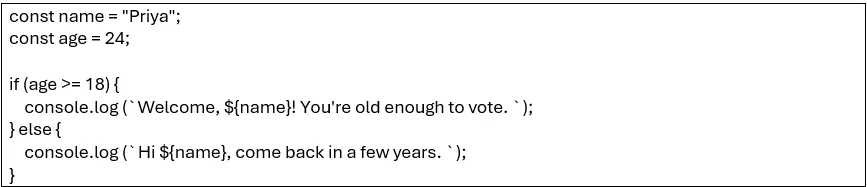
JavaScript: JavaScript wasn’t originally developed and designed to be a general-purpose language. It was developed to make web pages interactive inside browsers. Over time, it became a full-stack powerhouse, but that history leaves some quirks in syntax.
Example of JavaScript
The logic is almost the same, but JavaScript adds a few extra pieces, such as curly braces, const declarations, and console.log. It also has some common beginner challenges, including type coercion, the this keyword, and asynchronous programming.
That said, JavaScript has one big advantage: you can see results instantly in the browser. Change a line of code, refresh the page, and watch the difference right away. For beginners who stay motivated by quick visual feedback, this makes JavaScript especially appealing.
What You Can Build with Each Language
What Python Is Used For:
Artificial Intelligence and Machine Learning: Python powers a large share of AI development. According to the Stack Overflow, 2025 developer survey, Python reached 58% usage after a 7 percentage-point year-over-year jump, reflecting strong momentum in AI, data science, and back-end development. Tools like TensorFlow, PyTorch, scikit-learn, and Hugging Face are all Python-first. If you want to build AI models or work with LLMs, Python is a strong starting point.
Data Science and Analytics: Libraries like Pandas, NumPy, and Matplotlib have made Python the standard for data work. Whether you are cleaning spreadsheets, building dashboards, or running statistical models, Python is the tool.
Backend Web Development: Python frameworks like Django and Flask power the backends of Instagram, Pinterest, and Spotify. Server-side logic, APIs, and databases are very much Python’s territory.
Automation and Scripting: Need to rename 10,000 files, scrape data from a website, or automate a repetitive task? Python scripts handle these jobs elegantly with very little code.
Cybersecurity: Python is central to security work, including writing penetration-testing tools, automating security audits, and building internal scripts. It is a key skill for ethical hackers and security analysts.
What JavaScript Is Used For:
Artificial Intelligence and Machine Learning: Python powers a large share of AI development. According to the Stack Overflow, 2025 developer survey, Python reached 58% usage after a 7 percentage-point year-over-year jump, reflecting strong momentum in AI, data science, and back-end development. Tools like TensorFlow, PyTorch, scikit-learn, and Hugging Face are all Python-first. If you want to build AI models or work with LLMs, Python is a strong starting point.
Data Science and Analytics: Libraries like Pandas, NumPy, and Matplotlib have made Python the standard for data work. Whether you are cleaning spreadsheets, building dashboards, or running statistical models, Python is the tool.
Backend Web Development: Python frameworks like Django and Flask power the backends of Instagram, Pinterest, and Spotify. Server-side logic, APIs, and databases are very much Python’s territory.
Automation and Scripting: Need to rename 10,000 files, scrape data from a website, or automate a repetitive task? Python scripts handle these jobs elegantly with very little code.
Cybersecurity: Python is central to security work, including writing penetration-testing tools, automating security audits, and building internal scripts. It is a key skill for ethical hackers and security analysts.
Job Market and Salary Data
Job Volume
Python is dominating Indian job portals right now. A quick search on Naukri, LinkedIn India, and Internshala shows Python-tagged roles crossing 45,000+ active listings across India spanning IT services, product startups, fintech, edtech, and government tech initiatives like Digital India and ONDC.
JavaScript isn’t far behind with 30,000+ active listings, but thousands of additional roles are posted under “React Developer,” “MERN Stack Developer,” or “Node.js Engineer” which are among the most searched job titles on Naukri in 2026.
India’s booming startup ecosystem from Bengaluru and Hyderabad to Pune and Chennai is hiring both aggressively. But the fastest growth is clearly in AI and data roles, almost all of which require Python.
Salary Breakdown
| Role | Fresher (0–1 yr) | Mid-Level (2–4 yr) | Senior (5+ yr) |
| Python Developer | ₹3–5LPA | ₹5–9 LPA | ₹9–15+ LPA |
| JavaScript / Frontend Dev | ₹3.5–5 LPA | ₹5–8 LPA | ₹10–16 LPA |
| ML / AI Engineer (Python) | ₹4–7 LPA | ₹8–12 LPA | ₹15–28+ LPA |
| Full-Stack JS Developer | ₹4–6 LPA | ₹7–12 LPA | ₹15–25 LPA |
| Data Engineer (Python) | ₹5–8 LPA | ₹10–18 LPA | ₹20–40 LPA |
| React Developer | ₹4–6 LPA | ₹7–10 LPA | ₹12–20 LPA |
Python vs JavaScript for AI
The AI boom in India is accelerating quickly. India is not just consuming AI; it is also becoming a major hub for AI talent and services. Global tech companies are expanding AI centers of excellence in cities such as Hyderabad, Bengaluru, and Pune to hire engineering talent. According to the TIOBE Index, Python remained the #1 language in May 2026 with a rating of 19.98%, while JavaScript ranked #6.
Career Paths for Indian Jobseekers
After Learning Python, You Can Pursue:
- Data Scientist / Analyst — search live roles on Naukri and LinkedIn India
- Machine Learning Engineer — high-paying roles at product companies.
- Backend Developer (Django, FastAPI) — strong demand for fintech and healthtech.
- Automation / QA Engineer — large demand for IT services.
- Cloud / DevOps — Python on AWS, Azure, GCP; certifications at AWS Training India and Google Cloud Skills Boost
- Cybersecurity Analyst —for India-specific security career resources
- Government Tech / DRDO / ISRO — check DRDO recruitment portal and ISRO careers
After Learning JavaScript, You Can Pursue:
- Frontend / React Developer — most-hired role on Naukri React jobs
- MERN Stack Developer — search LinkedIn MERN India; extremely popular at Indian SaaS startups
- React Native Developer — mobile app roles at companies like Swiggy, Zepto, Jio, and more
- Freelancer / Agency Developer — Upwork and Fiverr are top platforms for Indian JavaScript freelancers
- Full-Stack Developer at Indian startups — Razorpay Careers, CRED Careers, Zerodha Careers all hire JS-heavy teams
- UI Engineer at product companies — You can check companies like Meesho Careers, Urban Company Careers
Which Should YOU Learn First? (For Indian Students and Freshers)
Learn Python First If You:
- Are an engineering student targeting data science, AI, or analytics.
- Are preparing placements at product companies.
- Want to crack roles at Google, Microsoft, Amazon India.
- Are from a non-CS background and want to break into tech via analytics.
- Want to pursue free, government-certified courses.
Learn JavaScript First If You:
- Are targeting frontend or full-stack roles at Indian startups.
- Want to freelance, since platforms like Upwork and Fiverr are dominated by JS and React skills.
- Want to build and ship your own product.
- Prefer to learn through community-led content.
Common Myths Indian Students Believe – Debunked
- Myth 1: “Python is only for IIT/NIT students or maths toppers.”
- Reality: Thousands of developers from tier-2 and tier-3 colleges have built successful careers in AI, automation, and backend development using Python. Skills and consistency matter more than college names.
- Myth 2: “Only Java and C++ get jobs in service companies.”
- Reality: Companies like Tata Consultancy Services, Infosys, and Wipro are actively using Python for AI, cloud, and automation projects.
- Myth 3: “JavaScript is only for frontend design.”
- Reality: Modern JavaScript powers full SaaS platforms, APIs, mobile apps, and startups through stacks like MERN.
- Myth 4: “I must learn multiple languages before applying for jobs.”
- Reality: One strong language plus real project on GitHub matters more than knowing many technologies superficially.
- Myth 5: “My first programming language decides my entire career.”
- Reality: Developers switch languages and tech stacks all the time. Your first language is just the starting point, not your final destination.
The AI Coding Assistant Factor – Extra Valuable for Indian Learners
AI coding assistants like GitHub Copilot, Cursor, and Claude have transformed what it means to be a beginner. A 2025 GitHub study found 26% productivity gains for developers using AI tooling daily to read the full report at github.blog.
For Indian students
- Students in tier-2 and tier-3 cities with limited access to senior mentors now have a 24/7 coding guide at zero cost
- For students who want structured learning alongside AI support, joining a Python training program can accelerate progress by combining mentorship, real-world assignments, and guided career preparation.
- Claude.ai and ChatGPT can explain errors, suggest fixes, and teach concepts in plain English or even Hindi.
- Self-taught developers building portfolios can use GitHub Copilot’s free tier directly in VS Code.
- Google Collab gives free cloud-based Python notebooks with GPU access invaluable for AI learning without expensive hardware.
Final Verdict
At the end of the day, both Python and JavaScript are outstanding first languages and in India’s 2026 job market, both will get you hired. If you are an engineering student eyeing AI, data science, or high-paying product company roles, start with Python it’s the language powering India’s biggest career opportunity right now. If you want to build websites, join a startup, or start freelancing on Fiverr and Upwork quickly, start with JavaScript. But here’s what nobody tells you: the students who get the best jobs aren’t the ones who picked up the “right” language. They are the ones who stopped debating and started building.
Your questions, our answers
In most cases, yes. Python’s syntax is usually simpler and more readable, which helps beginners focus on programming concepts instead of punctuation and structure.
Yes. Many entry-level roles ask for one primary language plus problem-solving skills and projects. Python is strong for AI, data, and automation roles, while JavaScript is strong for web and full-stack roles.
Yes. Python remains the dominant language for AI, machine learning, and data science because of its mature ecosystem, libraries, and community support.
Yes. With JavaScript, you can build front ends, back ends, APIs, and even mobile apps using tools like Node.js and React Native.
If your main goal is web development, JavaScript is usually the better first choice because it runs directly in the browser and is essential for frontend development. Python is still useful later for backend work.