Landing an interview today takes more than listing your qualifications on a well-designed resume. Most employers use Applicant Tracking Systems (ATS) to organize applications, while recruiters often spend only a few seconds deciding whether a resume deserves a closer look. As a result, even highly qualified candidates can miss opportunities if their resumes are poorly formatted, lack relevant keywords, or fail to communicate achievements effectively.
This is where AI resume analyzers come in. These tools evaluate your resume from both a machine’s and a recruiter’s perspective, identifying issues that could reduce your chances of getting noticed. They don’t replace your skills or experience, but they can help you present them more effectively. In this guide, we will explain what AI resume analyzers are, how they work, how they differ from ATS software and traditional resume checkers, who should use them, and how to use them to improve your resume before applying for your next job.
Key Takeaways
- AI resume analyzers evaluate your resume for both ATS compatibility and recruiter readability.
- Most ATS platforms don’t automatically reject resumes, they parse, organize, and rank candidates for human review.
- Common resume issues include formatting problems, parsing errors, missing keywords, weak bullet points, and grammar mistakes.
- Modern AI resume analyzers use natural language processing (NLP) to understand context instead of relying solely on exact keyword matches.
- AI resume analyzers and ATS software serve different purposes: ATS platforms help employers manage hiring, while analyzers help job seekers optimize resumes.
- The most effective way to use an AI resume analyzer is to compare your resume against a specific job description and apply the recommendations thoughtfully.
- Resume scores should be treated as guidance, not guarantees, strong qualifications and relevant experience still matter most.
Why Do Resumes Get Rejected by ATS Software?
If you have spent any time job hunting recently, you have probably come across the claim that 75% of resumes are rejected by ATS before a human ever lays eyes on them. It’s a scary number, and it’s repeated so often that it’s practically folklore at this point. Except it isn’t really true, or at least, nobody has ever been able to prove it. Career consultant Christine Assaf traced the statistic back to a 2012 sales pitch from a company called Preptel, which shut down the following year without ever publishing a methodology behind the number.
So what’s actually going on? Recruiters who have spent years inside these systems tend to push back hard on the idea that ATS software is some all-powerful gatekeeper. As one former Amazon and Microsoft recruiter put it, treating the ATS like a genius AI filter is almost laughable to anyone who’s actually used one for hiring. Most platforms don’t auto-reject candidates just because a keyword is missing, they sort and rank, and a human still makes the final call on who gets seen.
That said, this doesn’t mean the ATS is harmless. It just means the damage happens differently than most people assume. Here’s where resumes genuinely run into trouble:
- Parsing failures: Multi-column layouts, tables, text boxes, headers, footers, and unusual fonts confuse the software trying to extract your information. When parsing breaks, entire sections of your resume can become invisible to the system, even though a human would read them just fine.
- File format issues: Scanned PDFs, image-based files, or documents saved in a format the employer’s system doesn’t expect can fail to load altogether.
- Keyword misalignment: ATS platforms lean heavily on keyword matching. If your resume describes a skill differently than the job description does, the system may not connect the dots, even when you are clearly qualified.
- Content and formatting problems once a human opens it: This is where the real filtering tends to happen. Vague bullet points, no metrics, generic phrasing, and, perhaps surprisingly, grammar. One survey found that 77% of hiring managers said they would reject a resume outright if it had typos or grammatical errors.
If you want to tackle these formatting and parsing pitfalls in more depth, our guide on how to make your resume ATS-friendly walks through the specific fixes for each one.
What is an AI Resume Analyzer? (Definition)
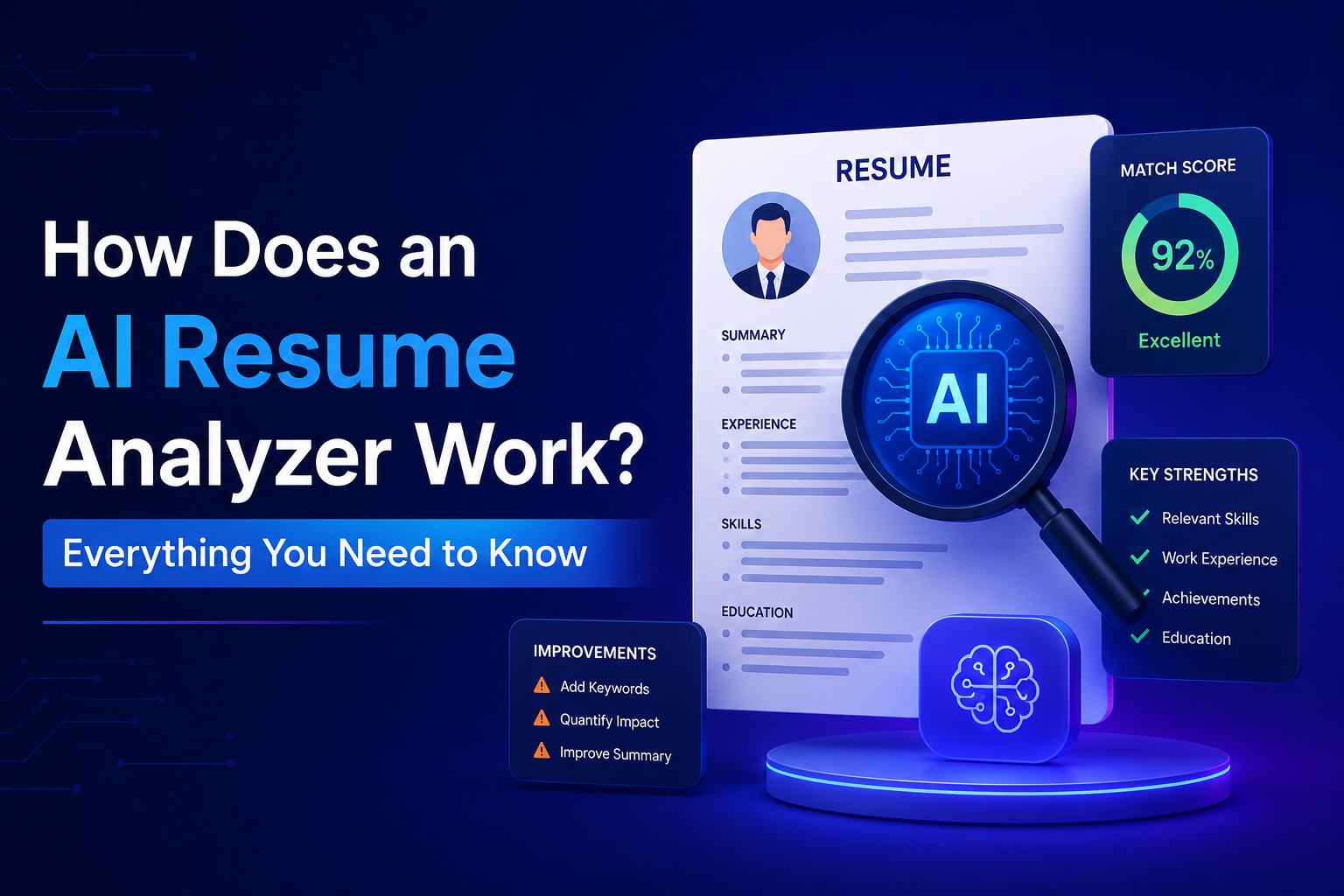
An AI resume analyzer is a tool that reviews your resume the way a recruiter or an ATS would, then hands back a report on what’s working, what isn’t, and what to fix. Instead of guessing why your applications go quiet, you get a concrete breakdown: your keyword alignment, how your bullet points read, whether your formatting will survive an automated scan, and often a numeric score you can try to improve.
Academic researchers describe it in similar terms: an AI resume analyzer is an artificial-intelligence-based system that reviews a candidate’s resume and generates suggestions for improvement, using machine learning to spot weak spots, say, a work experience section that’s too wordy, or skills that are buried instead of highlighted.
In practice, these tools sit on the job-seeker’s side of the table. Platforms like Jobscan, Rezi, Enhancv, Resume Worded, and Kickresume all fall under this umbrella. Some use rule-based scoring, others plug into large language models like GPT-4 to simulate the kind of feedback a real recruiter might give. Either way, the goal is the same: help you see your resume the way the hiring process sees it, before you hit submit.
How Does an AI Resume Analyzer Work?
Under the hood, an AI resume analyzer usually works in a few distinct stages. None of it is mysterious once you break it down.
Step 1: Parsing the resume
The tool first extracts your resume’s raw text and organizes it into structured fields, your name, contact details, education, work history, skills, and certifications. This is the same first step a traditional ATS takes, and it’s why formatting matters so much: a resume parser can only work with what it can actually read.
Step 2: Understanding the content with NLP
This is where things go beyond basic keyword spotting. Modern analyzers use natural language processing techniques such as tokenization, lemmatization, and named entity recognition to understand the contextual meaning of your resume rather than just matching exact words. So instead of penalizing you for writing “led a team” when the job post says, “managed a team,” a well-built system can recognize these as semantically similar through techniques like semantic similarity analysis or TF-IDF and cosine-similarity scoring.
Step 3: Comparing your resume against the job
If you provide a job description, the analyzer compares your parsed data against it, looking at required skills, experience level, and role-specific keywords. Some systems then classify your fit into categories like “fit,” “close fit,” or “not fit,” based on how closely your background lines up.
Step 4: Scoring and generating feedback
Finally, the tool produces a score or grade, usually broken down by category, such as ATS compatibility, keyword match, formatting, and writing quality, along with specific, actionable suggestions. Some of the more advanced tools now layer a large language model on top of this analysis specifically to generate feedback that reads like it came from an actual recruiter, rather than a checklist.
AI Resume Analyzer vs. ATS: What’s the Difference?
These two get lumped together constantly, but they’re built for different people solving different problems.
| Applicant Tracking System (ATS) | AI Resume Analyzer | |
| Who it’s for | Employers and recruiters | Job seekers |
| What it does | Manages the full hiring pipeline, storing candidates, organizing applications, enabling team collaboration and reporting | Reviews a single resume and gives feedback on how to improve it |
| How it decides | Parses and ranks applicants for recruiters to review, rather than issuing outright rejections on its own | Simulates or reverse-engineers how ATS platforms and recruiters are likely to read your resume |
| Where it lives | Behind the scenes, inside company hiring software (e.g., Workday, Greenhouse, Lever, BambooHR) | A website or app you use directly, on your own resume |
Some AI resume analyzers go as far as reverse-engineering the behaviour of specific major ATS platforms, so their feedback reflects how a particular company’s software is likely to parse your file. That’s the core relationship: the ATS is employer-side infrastructure, and the AI resume analyzer is the candidate’s way of peeking behind the curtain before applying.
AI Resume Analyzer vs. Resume Checker: What’s the Difference?
This distinction is subtler, and honestly, the two terms overlap quite a bit in how people use them today. But there is a meaningful difference in emphasis.
Resume Checker: A traditional resume checker is generally built to improve how your resume reads to a human. It focuses on grammar, tone, clarity, and formatting, and it typically hands back a score or a set of polish-level suggestions. It’s less concerned with whether a machine can parse your file and more concerned with whether a recruiter enjoys reading it.
AI Resume Analyzer: An AI resume analyzer (sometimes marketed as an ATS score checker) tends to go a step further. Alongside grammar and readability, it evaluates machine readability itself: keyword alignment with a specific job description, section structure, and formatting compliance that would trip up an actual ATS parser. In many modern tools, this line has blurred almost completely, the same platform will grade your writing quality and your ATS compatibility side by side, since ATS checkers focus mainly on parsing and keyword match, while AI resume checkers also weigh in on bullet strength, clarity, structure, and tailoring to the role.
The practical takeaway: if a tool only checks tone and grammar, it’s a resume checker in the classic sense. If it also scores you against a job description and simulates ATS parsing, you are using a fuller AI resume analyzer, even if the branding says “checker.”
Who Should Use an AI Resume Analyzer?
These tools aren’t only for people who are desperate after months of silence. A few groups tend to get the most value out of them:
- Active job seekers applying to multiple roles: If you are tailoring your resume for different postings every week, an analyzers speeds up the process of catching keyword gaps for each one.
- Career changers: When you are moving into a new industry, your existing resume often uses the wrong vocabulary for the field you are targeting. An analyzer helps surface the terminology gap.
- Students and early-career candidates: Those building their first professional resume often don’t yet know what “good” looks like structurally, and these tools provide fast, judgment-free feedback along with keyword and formatting guidance.
- People applying at high volume: If you are sending out dozens of applications, running each version through an analyzer first catches formatting or parsing issues before they cost you a shot at the role.
- Recruiters, career centers, and institutions: Some versions of this technology are also used by colleges and career-services teams to get a broader sense of how their students’ resumes are shaping up before placement season, or by recruiting teams looking to reduce manual screening effort.
How to Use an AI Resume Analyzer to Improve Your Resume Score?
Running your resume through an analyzer is the easy part. Getting real value out of it takes a bit more intention. Here’s a workflow that actually moves the needle:
- Paste in the job description, not just your resume: Most analyzers are far more useful when they can compare your resume against a specific posting rather than scoring it in a vacuum, this is what generates the keyword-gap analysis you actually need.
- Read the full report before touching anything: Look at the breakdown by category (often things like impact, keywords, structure, and clarity) so you know where the weak points really are instead of guessing.
- Fix the highest-impact issues first: Swap weak openers like “responsible for” or “helped with” for strong action verbs such as “led,” “built,” or “increased,” and add numbers wherever you can, percentages, dollar figures, timeframes, team size. This is especially true for your skills section — vague or buried skills lists are a common culprit here, so it’s worth reviewing our guide on listing your technical skills clearly to make sure this section is pulling its weight.
- Mirror the job description’s language, don’t fight it: If the posting says “cross-functional collaboration” and you wrote “worked with other teams,” align your phrasing. This is often the single biggest lever for keyword match.
- Rewrite AI suggestions in your own voice: Be careful here, some hiring managers actively screen for content that sounds AI-generated, and one survey found that 49% would reject a resume they believed was written by AI. Use the tool’s suggestions as a starting point, then rewrite so it sounds like you, and stays accurate to your real experience.
- Re-run the analysis after editing: Treat your score as a feedback loop, not a one-time grade. Most platforms let you re-scan for free, so keep iterating until the gaps close.
- Don’t treat the score as gospel: A 90% match doesn’t guarantee an interview, and a 60% match doesn’t mean automatic rejection. Use the score to spot patterns and blind spots, not as a pass/fail verdict.
Conclusion
AI resume analyzers have become valuable tools for job seekers looking to improve their resumes before applying. By combining ATS compatibility checks, keyword analysis, writing feedback, and formatting recommendations, they help identify issues that are often difficult to spot on your own.
However, no AI tool can guarantee interviews or job offers. Hiring decisions still depend on your qualifications, experience, and how well you match the role. Think of an AI resume analyzer as a second set of expert eyes, it helps you present your experience more effectively while reducing avoidable mistakes that could hurt your chances. Used alongside thoughtful customization for each application, it can make your resume stronger, clearer, and more competitive.
Your questions, our answers
An AI resume analyzer is a tool that reviews your resume using artificial intelligence to evaluate factors such as ATS compatibility, keyword relevance, formatting, readability, and writing quality. It then provides recommendations to improve your resume before you apply for a job.
No. While it can improve your resume's quality and alignment with a job description, interview decisions ultimately depend on your qualifications, experience, competition, and the employer's hiring process.
No. An ATS is software employers use to manage job applications throughout the hiring process. An AI resume analyzer is a job-seeker tool that helps optimize resumes for ATS compatibility and recruiter review.
Most modern AI resume analyzers are reasonably accurate at identifying formatting issues, keyword gaps, and writing improvements. However, their scores should be viewed as guidance rather than an exact prediction of hiring outcomes.
Yes. Customizing your resume to reflect the skills, responsibilities, and terminology used in each job description generally improves its relevance and can increase your chances of being shortlisted.
Yes. Many tools identify formatting elements that may cause ATS parsing issues, including tables, multiple columns, text boxes, headers, footers, and unsupported file formats.
Yes, but you should review and edit the suggestions to ensure they accurately reflect your experience and sound natural. Recruiters value authenticity, and overly generic AI-generated language can make your resume less persuasive.
Free tools can be useful for identifying basic issues like formatting, grammar, and keyword gaps. Premium versions often provide more detailed analysis, ATS simulations, personalized recommendations, and additional resume optimization features.
There is no universal benchmark because scoring systems vary by platform. Rather than focusing on achieving a perfect score, use the feedback to improve keyword alignment, readability, and ATS compatibility.
Use one before submitting any important job application, especially after tailoring your resume to a specific job description. Running a final scan can help catch formatting errors, missing keywords, and writing improvements before you apply.