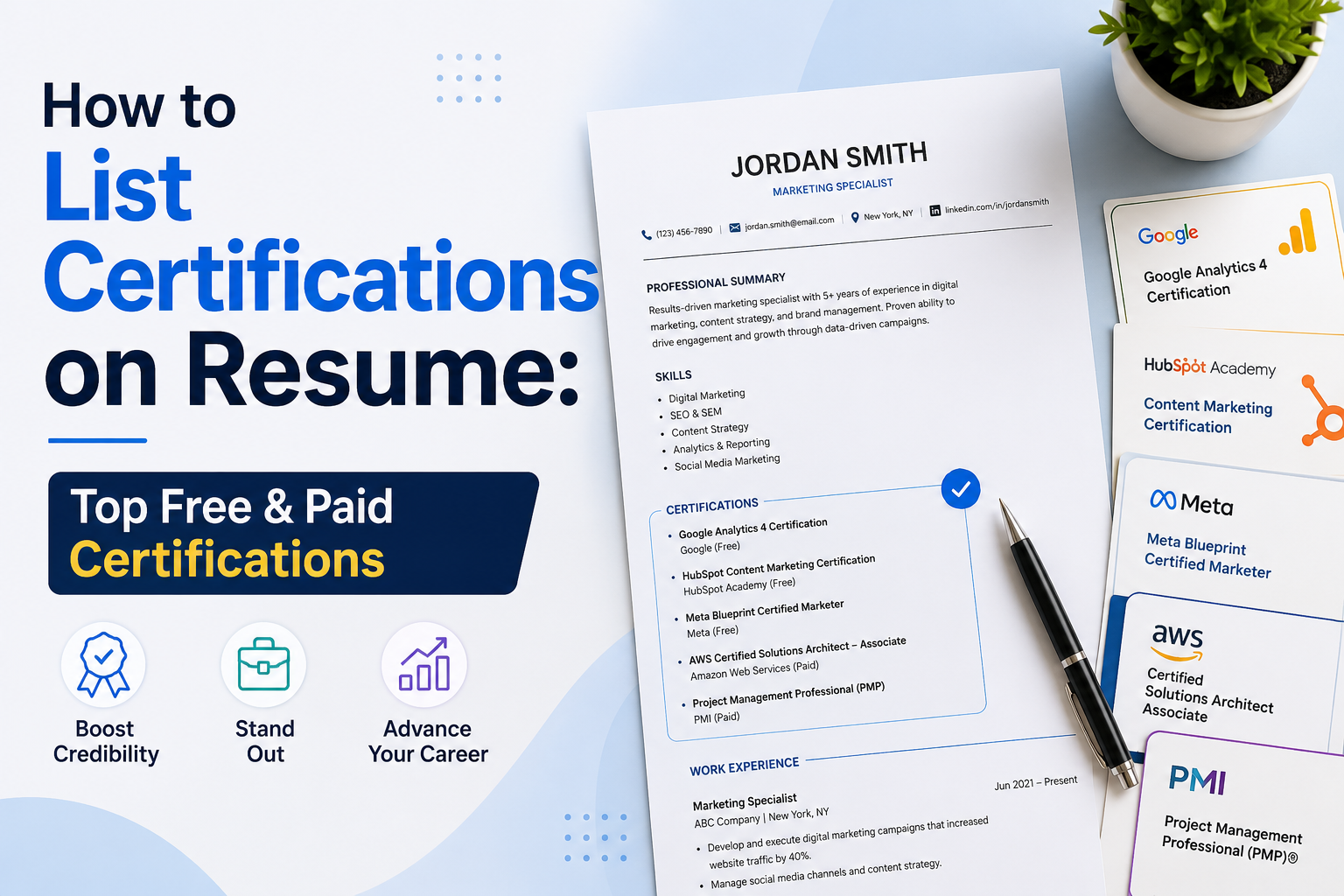
Employers are looking for more than just degrees and work experience, they want proof that candidates have the skills needed to succeed. Certifications provide that proof by validating your expertise, commitment to professional growth, and ability to stay current in an evolving industry. Whether you are a recent graduate, a career changer, or an experienced professional, listing certifications correctly on your resume can improve your chances of passing applicant tracking systems (ATS) and catching the attention of hiring managers.
This guide explains how to list certifications on your resume the right way, where to place them for maximum impact, and which free and paid certifications are most valuable across different industries. You will also learn ATS-friendly formatting tips, common mistakes to avoid, and how to choose certifications that align with your career goals.
Key Takeaways
- Certifications strengthen your resume by providing verifiable proof of your skills and professional expertise.
- Include the full certification name, issuing organization, completion date, and expiration or renewal date (if applicable).
- Place certifications in a dedicated “Certifications” section, your resume summary, education section, or header depending on their importance.
- Use ATS-friendly formatting by avoiding tables, graphics, and non-standard section headings.
- Clearly label unfinished credentials as “In Progress” and include the expected completion date.
- Prioritize certifications that are directly relevant to the job you’re applying for.
- Free certifications from recognized providers such as Google, IBM, HubSpot, Harvard, and Microsoft can significantly enhance entry-level resumes and career transition profiles.
- Paid certifications often carry greater value for specialized or senior-level roles in fields like cloud computing, cybersecurity, project management, and finance.
- Remove outdated or expired certifications unless they remain relevant and have been renewed.
- Combine certifications with practical projects and work experience to demonstrate real-world application of your skills.
Why Certifications Matter on a Resume?
In today’s skill-based hiring environment, certifications do more than pad a resume, they act as verifiable proof of competence. According to Jobscan’s State of the Job Search survey, roughly half of recruiters (50.6%) filter candidates by certifications and licenses when searching applicant tracking systems (ATS), making a well-formatted certifications section a genuine ranking factor, not just a nice-to-have.
Certifications are especially valuable in three scenarios: when you are entering a new industry with limited direct experience, when a job posting explicitly requires a credential, and when you want to prove you are staying current in a fast-changing field like cloud computing, cybersecurity, or digital marketing.
The 5 Elements of a Properly Listed Certification
Career experts consistently point to the same core components for listing any certification correctly.
- Full Certification Name: spelled out in full, with the common abbreviation in parentheses (e.g., “Project Management Professional (PMP)”).
- Awarding Institution: the organization, board, or company that issued the credential.
- Date Awarded: month and year you completed the certification.
- Expiration or Renewal Date (if applicable): many certifications, like PMP or CISSP, require periodic renewal, and listing this shows your credential is current.
- Relevant skills: a short note on the skills gained, tailored to the job you are applying for.
Harvard’s career services office adds that if you are still working toward a certification, you should clearly mark it as “In Progress” and include the expected completion date, so hiring managers understand exactly where you stand.
For certifications tied to licensure, such as nursing or accounting credentials, Harvard notes that you can also add the abbreviation directly after your name at the top of your resume (for example, “Priya Anand, RN” or “Timothy Oluwa, CPA”), which immediately signals you meet a non-negotiable job requirement.
Where to Place Certifications on Your Resume?
| Placement | Best For |
| Dedicated “Certifications” section | Most candidates, especially if you have 2 or more certifications relevant to the job. Typically placed after Experience and Education. |
| Resume summary/headline | When the certification is a hard requirement for the role or is your single most impressive credential (e.g., PMP for a project manager role). |
| Next to your name in the header | Licensed professions where the credential is essential to practice, such as RN, CPA, or PE. |
| Combined with Education | If you only have one or two certifications, or they were earned as part of a degree program, keeps the resume concise. |
Formatting Examples by Section
Dedicated Certifications Section
| Certifications
Project Management Professional (PMP) – Project Management Institute, June 2024 Certified ScrumMaster (CSM) – Scrum Alliance, January 2023 AWS Certified Solutions Architect – Associate – Amazon Web Services, March 2025 (Expires: March 2028) |
In the Resume Summary
| Detail-oriented Financial Analyst with 5+ years of experience developing and presenting insights that guide executive decisions. Holds an M.S. in Accounting and a CFA certification, with strong expertise in financial modelling software. |
In-Progress Certification
| Professional Educator License (PEL) | State Board of Education | Expected: January 2027 |
Combined With Education
| B.A. in Marketing – University of State, 2022
Certifications: Google Analytics Certification (2023), HubSpot Content Marketing (2024) |
ATS Formatting Rules You Can’t Skip
Because most companies now route resumes through an applicant tracking system before a human ever sees them, formatting isn’t just cosmetic, it determines whether your certification is even detected.
- Spell out the full name plus the acronym. If a recruiter’s ATS search only matches “Project Management Professional” and your resume only says “PMP,” you may not surface in results.
- Use standard section headers like “Certifications” or “Professional Credentials”, creative titles such as “My Badges” may not be recognized by parsing software.
- Avoid tables, text boxes, and graphics in the certifications section, per Resume Genius, plain text keeps your resume readable by both ATS software and recruiters.
- List in reverse chronological order, most recent first, unless you are intentionally prioritizing relevance over recency.
- Add a “Verify Credential” link or credential ID where possible. Harvard Business School Online notes this is now standard practice, letting recruiters confirm your credential in seconds.
Do’s and Don’ts
Do’s
- Bold the certification title so it’s easy to scan.
- Match font and size to the rest of your resume.
- Only include certifications relevant to the target job.
- Renew or remove expired certifications.
- Mirror the exact language job postings use for keyword matching.
Don’ts
- List short, low-effort courses (a few hours long) unless directly relevant.
- Include expired credentials without renewal plans.
- Use decorative section headers an ATS won’t recognize.
- Add irrelevant certifications (e.g., a culinary certificate on a finance resume).
- Forget to note “In Progress” status for unfinished certifications.
Top Free Certifications Worth Listing
Free certifications can meaningfully strengthen a resume when they come from recognized providers and are directly relevant to your target role. Resume.io’s 2026 guide emphasizes that certifications from Google, HubSpot, and IBM are widely respected because they teach practical, job-ready skills rather than abstract theory. Based on aggregated data from Jobscan, TailorCV, and Resume.io, here are the standout free options by category:
Google Data Analytics Certificate: Covers SQL, data visualization, and statistical analysis using real datasets. No prior experience required, ideal for career switchers into analytics.
HubSpot Inbound Marketing Certification: One of the most recognized free marketing credentials, covering campaign strategy, content, and inbound methodology.
Google Analytics (Skillshop): Proves you can read website traffic and digital performance data, valuable for SEO, marketing, and web management roles.
Harvard CS50 (Introduction to Computer Science): One of the most respected free courses worldwide; even partial completion signals strong problem-solving ability to recruiters.
IBM Data Science / Python Basics: Beginner-friendly courses covering Python, data visualization, and machine learning fundamentals, well-recognized in tech hiring.
Cisco Networking Academy / AWS Cloud Practitioner Essentials: Strong entry point into IT and cloud computing; foundational and beginner-friendly, per Jobscan’s certification roundup.
Other notable free platforms cited across multiple sources include Great Learning, freeCodeCamp, DataCamp, Saylor Academy, Kaggle, Cognitive Class, OpenLearn, and Microsoft Learn’s free learning paths.
Top Paid Certifications
| Certification | Avg. Total Comp | Key Area | Exam Cost | Difficulty | Renewal Period |
| AWS Solutions Architect – Professional | $190,000–$220,000 | Cloud Architecture | $300 | High | 3 years |
| Google Professional Cloud Architect | $180,000–$210,000 | Cloud Architecture | $200 | High | 2 years |
| CISSP | $175,000–$205,000 | Security Leadership | $749 | Very High | 3 years |
| CCSP | $170,000–$200,000 | Cloud Security | $599 | High | 3 years |
| CISM | $165,000–$195,000 | Security Management | $575–$760 | High | 3 years |
| AWS Security Specialty | $165,000–$195,000 | Cloud Security | $300 | High | 3 years |
| Azure Solutions Architect Expert | $160,000–$210,000 | Cloud Architecture | $165 (2 exams) | High | 2 years (annual renewal) |
| PMP | $150,000–$185,000 | Project Management | $284–$575 | Medium-High | 3 years |
| CKA / CKS | $155,000–$185,000 | Kubernetes / DevSecOps | $445 | High | 2 years |
| CCIE / CCNP Security | $150,000–$180,000 | Network Security | $400 | Very High | 3 years |
(Source: https://passitexams.com/articles/highest-paying-it-certifications/)
Paid Certification by Shine Dezign’s Industrial Training Programs
- If you are looking for a paid certification that pairs credential-building with real hands-on experience, Shine Dezign 6-month and 6-week industrial training programs in Mohali and Chandigarh are worth a look.
- Covering in-demand tracks like MEAN/MERN Stack, PHP/Laravel, Shopify, WordPress, DevOps, AI/ML, and Digital Marketing, each program pairs live-project mentorship with senior developers, monthly performance assessments, and HR sessions, culminating in a recognized training certificate you can list directly on your resume.
- With 98% of trained candidates going on to secure placements and 100+ students already trained, this certification doubles as both a skill validator and a launchpad into the IT industry.
- For freshers or career switchers who want a certification backed by tangible project experience rather than just video lectures, it’s a strong paid alternative to purely theoretical courses.
How to Choose Between Free and Paid?
Free certifications are ideal for demonstrating initiative, testing interest in a new field, or supplementing an existing resume with a relevant, recognizable name (Google, IBM, HubSpot). Paid, exam-based certifications tend to matter more once you are targeting mid-to-senior roles or fields with regulatory or industry-standard requirements, project management, cloud architecture, cybersecurity, accounting, and HR leadership among them. The Interview Guys note that many employers offer tuition reimbursement or professional development budgets, so it’s worth checking with HR before paying out of pocket.
Conclusion
A well-presented certification section can make your resume more competitive by showcasing verified skills that employers trust. Beyond simply listing credentials, the way you format and position them can influence whether your resume passes ATS screening and captures a recruiter’s attention. Focus on certifications that are relevant to your target role, keep your information up to date, and use recognized credentials that align with your career goals.
Whether you choose free learning opportunities to build foundational skills or invest in industry-recognized professional certifications, each credential should support the story your resume tells about your expertise and growth. When combined with relevant experience and measurable achievements, certifications become a powerful tool for standing out in today’s skills-driven hiring landscape.
Your questions, our answers
Yes, mark it clearly as "In Progress" with an expected completion date, so the recruiter understands your current status rather than assuming it's complete.
On a traditional resume, it typically follows your Experience and Education sections. If the certification is required for the role or especially prestigious, move it into your summary or near the top instead.
Yes, when they come from a recognized provider (Google, IBM, HubSpot, Harvard, etc.) and are directly relevant to the target job, they are most effective when paired with real project work or examples that show you applying the skill.
Generally, yes. Resume Genius and Resume Worded both note that listing expired credentials can raise questions about your commitment to staying current, renew them if the certification is still relevant, or remove them if not.
Not necessarily, it depends on the role and industry. Paid, exam-based certifications like PMP or CISSP carry more weight for licensed or highly technical senior roles, while free certifications from strong providers work well for entry-level roles or career pivots.