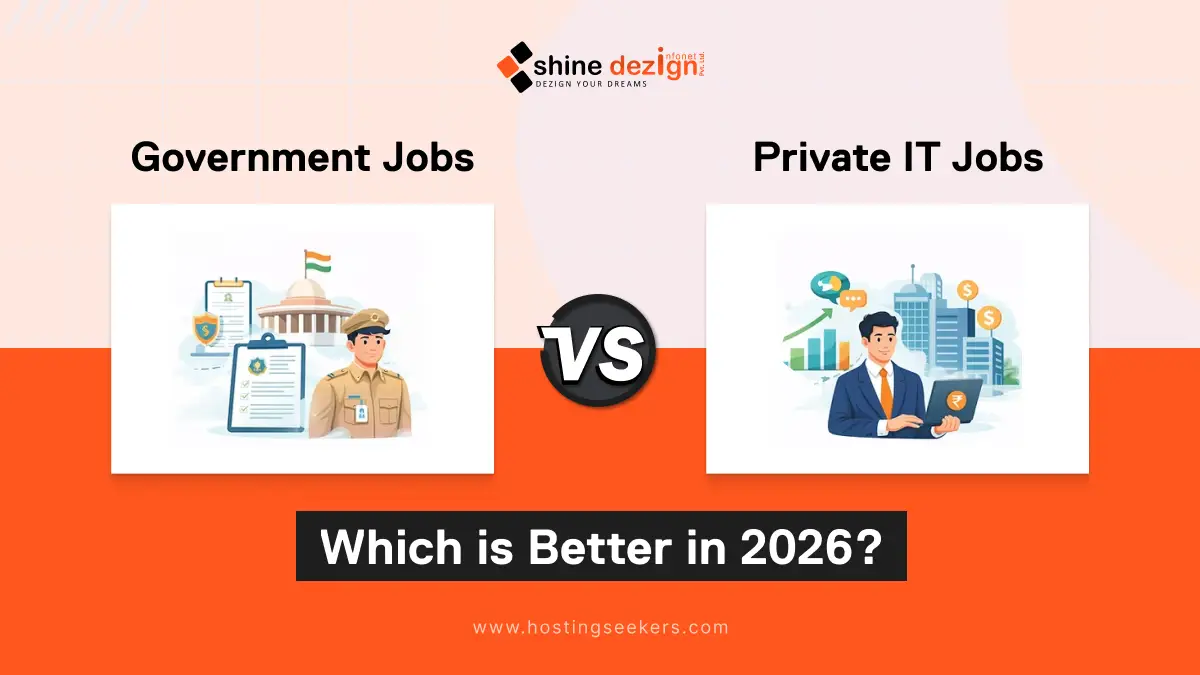
Every year, millions of Indian graduates face the same crossroads: chase a stable government job or take the plunge into the private IT sector? In 2026, that question has become even more interesting, and more complicated.
On one side, the Indian government is rolling out the 8th Pay Commission, which is expected to hike central government salaries by 25–34% when implemented. On the other, India’s tech industry is set to cross $315 billion in revenue in FY26, adding roughly 135,000 net new jobs, with AI and cloud skills commanding serious premiums.
Neither path is objectively “better.” What matters is what you actually value, because these two career tracks reward very different things. This guide breaks it all down with real numbers, current data, and zero vague advice.
Key Takeaways
- Government jobs provide superior job security and strong legal protections against layoffs.
- Private IT professionals generally have higher earning potential, especially in product-based and global tech companies.
- The 8th Pay Commission is expected to significantly increase government salaries.
- Government employees benefit from pension, CGHS healthcare, gratuity, and other retirement advantages.
- IT sector salary growth is faster and often driven by performance and job switches.
- Career progression in government jobs is generally slower and seniority-based.
- IT careers require continuous upskilling, especially in AI, cloud computing, and cybersecurity.
- Government jobs suit those seeking stability, while IT careers suit those pursuing rapid growth and higher rewards.
Salary Ranges: What Are People Actually Taking Home?
Let’s start with numbers. Both sectors have a wide range depending on role, experience, and the specific employer, so comparing “government” vs “IT” at the top level can be misleading. Here is how it actually breaks down.
Government Jobs: Salary Under 7th Pay Commission (Current): Central government salaries are structured through the Pay Matrix system introduced by the 7th Central Pay Commission. As of 2026, Dearness Allowance (DA) stands at 60% of basic pay, effective January 2026.
Government Roles
- Clerical / Group C: ₹18K–₹35K/mo
- SSC CGL / Bank PO: ₹35K–₹65K/mo
- IAS / IPS (Entry): ₹56K–₹70K/mo
- IAS (Senior/Cabinet): Up to ₹2.5L/mo
- PSU Officers (Avg): ₹60K–₹1.2L/mo
Private IT Roles
- Fresher (Service co.): ₹3.5–5 LPA
- Fresher (Product co.): ₹6–12 LPA
- Mid-Level (3–6 yrs): ₹10-25 LPA
- Senior / Lead: ₹25-50 LPA
- FAANG / Senior: ₹40-80+ LPA
In pure monthly take-home terms, a mid-level IT professional at a product company can comfortably out-earn a senior government officer. But the comparison shifts once you factor in DA, HRA, LTC, CGHS, subsidised housing, and pension, all of which add significant value on top of a government salary.
8th Pay Commission Update (2026): The 8th Pay Commission was formally constituted on 3 November 2025 and is expected to revise salaries retrospectively from 1 January 2026. Experts project a fitment factor between 2.6 and 2.86, which would raise the minimum basic pay from ₹18,000 to potentially ₹46,000–₹51,000. Full implementation is expected in FY 2026–27.
IT Salary Reality Check: The average software engineer salary in India across all experience levels and company types sits around ₹8 LPA, with the top 10% of engineers earning over ₹20 LPA. Freshers at service companies like TCS typically start at ₹3.5–4.5 LPA. The ₹40 LPA+ packages you see in headlines belong to senior roles at product/FAANG companies and represent a small fraction of the market.
Salary Hike & Appraisals: How Fast Can You Grow Your Pay?
This is where the two sectors differ most sharply. The pace, structure, and predictability of salary growth are completely different.
Government: Structured, Predictable, Revision-Driven
Government employees get a standard 3% annual increment on their basic pay under the current pay matrix system. Beyond that, a big pay jump only comes through:
- Pay Commission revisions: Every 10 years, with large lumpsum increases (7th CPC gave a 23.35% hike in basic; 8th CPC is expected to give 25-34%)
- MACP scheme: Modified Assured Career Progression gives a pay upgrade after 10, 20, and 30 years of service without a formal promotion
- DA revisions: Revised twice a year (January and July) to compensate for inflation; currently at 60% of basic pay as of January 2026
- Promotion-based hikes: Significant jumps in pay grade, but promotions in government take time
IT Sector: Performance-Linked, Variable, Company-Dependent
Annual hikes in the IT sector are tied to performance ratings, company revenues, and the broader macro environment. FY25 was a cautious year, major companies held back on aggressive hikes compared to the boom years of 2021–22.
- TCS (FY25: most employees): 4.5–7%
- TCS (FY25: top performers): 10%+
- Infosys (FY25: average): 5–8%
- IT sector: critical AI/ML skills: 20–40%
- Govt: Annual Increment (7th CPC): 3% of basic
- Govt: 8th CPC (expected, one-time): 25–34%
Sources: Business Standard (TCS Hike, Sep 2025) · Infosys Hike Data · Michael Page India Salary Guide 2025 · ClearTax 8th CPC
The IT sector can give you much faster absolute salary growth, especially if you switch companies every 2–3 years, which remains one of the most reliable ways to increase your CTC in the private sector. However, this growth is neither guaranteed nor uniform. In a tough year like FY25, even large companies kept hikes conservative, and some senior roles saw variable pay cuts. Government hikes are slower annually, but every Pay Commission revision is a large, guaranteed, and retroactive correction.
Job Security: The Single Biggest Differentiator
This is the clearest, most unambiguous win for government jobs, and it’s not close.
Government Job Security
Permanent government employees are protected under Article 311 of the Constitution, which ensures that no government servant can be dismissed, removed, or reduced in rank without a formal departmental inquiry, a chance to respond, and due process. No recession, no policy change, no quarterly earnings miss can cost a government employee their job. Key sectors like Railways and Defence have remained unaffected through every economic crisis since Independence.
IT Sector Job Security
The private IT sector has seen significant volatility. Between 2022 and 2024, tech companies globally laid off over 690,000 people, with Indian offices seeing close to 70,000 job cuts. TCS itself cut over 12,000 positions in 2025, its largest workforce reduction on record. While the sector as a whole remains a net hirer (NASSCOM projects 135,000 net new jobs in FY26), individual job security depends heavily on company performance, global macro conditions, and whether your skills stay relevant.
That said, job security in IT is not as fragile as headlines make it seem either. A skilled, continuously upskilling IT professional, especially one with expertise in AI, cloud, or cybersecurity, is genuinely hard to replace and faces much lower risk than a rote-skill worker. The threat in IT is mostly at the lower end of the skill curve, not for those who keep growing.
Benefits & Perks: Beyond the Monthly Salary
When you compare the two sectors, the salary numbers alone tell only part of the story. The benefits picture, especially for retirement, is where government jobs build a compelling long-term case.
| Government Job Benefits | Private IT Job Benefits |
| Pension (UPS/OPS), guaranteed 50% of last-drawn pay post-retirement. | Performance bonuses and annual variable pay (often 10–30% of CTC). |
| Government contributes 14% of Basic+DA to NPS (vs. your 10%). | ESOPs / RSUs at product/startup companies. |
| Gratuity: lump sum of ₹15–20 lakh after 30 years; tax-free. | Employer PF contribution (12% of basic pay). |
| Leave Encashment up to 300 days (₹10–15 lakh at retirement). | Paid maternity leave (26 weeks as per law) + paternity leave. |
| CGHS: lifelong medical coverage for employee and dependents. | Group health insurance (typically ₹3–10 lakh cover for family). |
| HRA: 10–30% of basic pay depending on city class. | Internet/phone allowance + equipment for WFH roles. |
| DA: 60% of basic pay as of Jan 2026; revised every 6 months. | Learning & development budgets for upskilling. |
| Leave Travel Concession (LTC) for self and family. | Flexible/remote work options, widespread post-pandemic. |
| Government housing or subsidised housing in major cities. | Gratuity after 5 years of service (updated eligibility from Nov 2025). |
| 14 gazetted holidays + earned leave + casual leave. | Flexible benefits basket in some large companies. |
The retirement picture especially favours government employees. An SSC CGL employee retiring after 30 years can expect a total retirement package (pension payments over 20–25 years, gratuity, leave encashment) worth over ₹1.5–2 crore. The CGHS alone, which provides lifelong medical coverage to the employee, spouse, and dependent parents, has a replacement cost in the private sector of several lakh rupees over a lifetime.
Private IT companies have improved their benefits significantly, but most cannot match the pension and post-retirement medical security that government employment offers. The 2025 gratuity rule changes did help private sector workers, fixed-term and contract employees now qualify after just one year of service, but pensions remain limited to NPS-equivalent structures.
Career Growth: Speed vs. Stability
Government: Seniority-Driven, Structured Progression
Promotions in government are largely time-bound and exam-driven. In most central government departments, reaching the next pay level takes around 5–10 years, unless you crack departmental promotion exams or are in the civil services (IAS/IPS), where career milestones are more structured but still relatively slow compared to the private sector. The MACP scheme guarantees a financial upgrade every 10 years even without a formal promotion, meaning your pay grows, but your designation and responsibilities may not.
IT Sector: Merit-Driven, Fast but Uncertain
The IT sector’s biggest draw for ambitious professionals is that promotions are not on a clock. If you perform well, you can move from junior developer to senior engineer in 3–4 years, or to a managerial role in 5–7 years. Company switching is also a recognised and common tool; many IT professionals see 20–25% salary jumps when switching companies with 2–3 years of experience.
In other words, this growth is performance-gated and market-sensitive. Economic downturns, project cancellations, and skill obsolescence can stall or reverse it. AI automation is now adding another layer of uncertainty, particularly for mid-tier service-model roles. Meanwhile, engineers with AI, cloud, and full-stack skills are seeing demand, and compensation, grow meaningfully faster than the market average.
Full Comparison Table: Government Jobs vs Private IT Jobs
Here is everything side-by-side, covering the factors most people actually care about.
| Factor | Government Jobs | Private IT Jobs |
| Starting Salary | ₹18,000–₹56,000/mo (Level 1 to IAS entry) | ₹3.5–12 LPA depending on company type |
| Mid-Career Pay | ₹35,000–₹1 lakh+/mo (with DA, allowances) | ₹10–25 LPA (service); ₹20–50 LPA (product) |
| Salary Ceiling | ₹2.5 lakh/mo (Cabinet Secretary) | Unlimited, FAANG seniors earn ₹80 lakh+ LPA |
| Annual Increment | 3% of basic (fixed) | 4.5–15% (performance-linked) |
| Pay Revision Cycle | Every 10 years (Pay Commission) | Annual appraisals |
| Job Security | Very high, Article 311 protection, no layoffs | Moderate, market-dependent; AI adding risk at lower skill levels |
| Pension | UPS: 50% of last drawn pay (lifetime) | No defined pension; NPS or EPF only |
| Gratuity | ₹15–20 lakh (tax-free) after 30 years | After 5 yrs (1 yr for contract from Nov 2025) |
| Health Insurance | CGHS, lifelong, covers family incl. parents | Group policy (₹3–10 lakh cover); ends with employment |
| DA / Cost of Living | DA at 60% of basic (Jan 2026); revised every 6 months | No formal DA; salary expected to keep pace with inflation |
| Work-Life Balance | Generally better, fixed hours, generous leave, public holidays | Variable, project-dependent; improved by WFH/hybrid post-2021 |
| Promotion Speed | Slow, time-bound or exam-based (10+ years typical) | Fast, performance-based; 3–5 years to senior roles possible |
| Skill Development | Limited formal investment; training varies by department | Strong, L&D budgets, certifications, global exposure, cutting-edge tools |
| Remote Work | Mostly office-based; limited WFH | Widespread hybrid/remote options, especially post-2021 |
| Entry Difficulty | Very high, UPSC, SSC, banking exams; years of preparation | Moderate; many entry routes available, degree, bootcamp, or structured internships and training programs |
| Social Prestige | Very high in Indian society, particularly civil services | Good, especially in urban/metro environments |
| Housing Benefit | Govt. housing or HRA (10–30% of basic based on city class) | HRA component in CTC; market rent otherwise |
| Sector Growth | Stable; vacancies depend on govt. policy | India IT sector revenue at ~$315B (FY26); 135K net new jobs |
| AI Disruption Risk | Low, most government roles are not easily automated | Moderate, lower-skill IT tasks at risk; high-skill roles still in demand |
The Verdict: Who Should Choose What?
There is no single right answer. But your priorities, risk tolerance, and life goals should make this a fairly clear decision once you are honest with yourself.
Choose Government Jobs If You:
- Prioritise financial security over maximum earning potential.
- Want a guaranteed pension and post-retirement medical cover.
- Value work-life balance and predictable working hours.
- Have dependents and need long-term stability.
- Want to serve the public and find meaning in that.
- Are based in Tier 2/3 cities where govt. pay is competitive.
- Are not keen on continuous skill upgradation under pressure.
Choose Private IT Jobs If You:
- Want faster salary growth and higher earning potential.
- Are comfortable with some degree of job uncertainty.
- Enjoy learning new technologies and evolving your skill set.
- Want flexibility, WFH, hybrid, startup culture.
- Are ambitious and want to grow fast without waiting a decade.
- Have a specific tech passion (AI, cloud, data, etc.).
- Are open to relocating to metros or working globally.
Conclusion
In 2026, the choice between a government job and a private IT job depends entirely on your career priorities. Government jobs offer unmatched job security, pension benefits, structured growth, and long-term financial stability. In contrast, private IT jobs provide faster salary growth, greater earning potential, flexible work options, and quicker career advancement for skilled professionals. Rather than asking which option is universally better, candidates should evaluate their risk tolerance, lifestyle preferences, and long-term goals before making a decision.
Your questions, our answers
Government jobs offer significantly higher job security due to constitutional protections and minimal layoff risk.
Yes. Mid-level and senior IT professionals, particularly in product-based companies, can earn substantially more than most government employees.
The 8th Pay Commission is expected to increase basic pay by approximately 25–34%, improving overall compensation for government employees.
Government jobs generally provide stronger retirement benefits through pension schemes, gratuity, leave encashment, and lifelong healthcare coverage.
Individuals who enjoy technology, continuous learning, higher earning potential, and faster career growth are likely to benefit more from the IT sector.