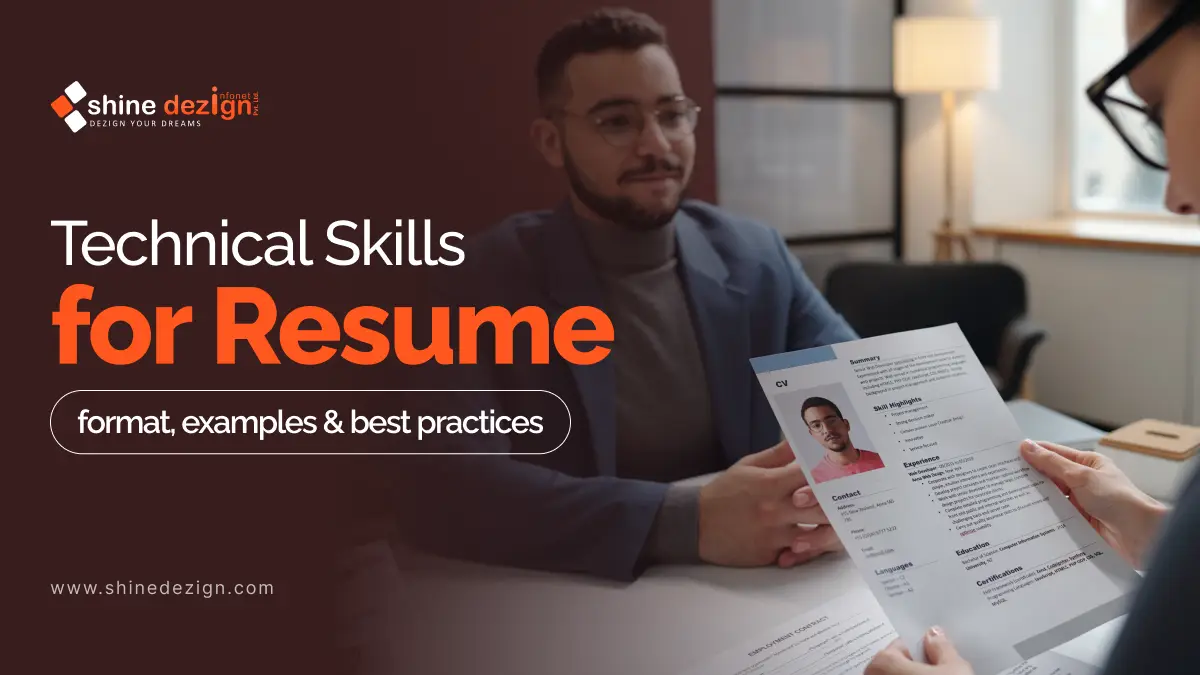
When it comes to building a strong resume, one section can make or break your chances of getting shortlisted, the technical skills section. Recruiters and ATS systems heavily rely on technical skills for resume screening to quickly identify qualified candidates.
Whether you are a fresher or an experienced professional, presenting your technical skills in the right format, with the right structure, is essential. In this guide, we will break down how to list, organize, and optimize your technical skills so your resume stands out and aligns with industry expectations.
TL; DR
- Technical skills are measurable hard skills (Python, SQL, Figma, etc.) that ATS systems and recruiters scan for first.
- Split them into primary skills (core to the role) and secondary skills (supporting tools).
- Best format: categorized list grouped by type — avoid skill bars or star ratings.
- Tailor your skills to each job description using the exact keywords from the JD.
- List 8–10 skills as a fresher, up to 20 at senior level.
- Place the section after education (freshers) or after work experience (senior pros).
- Never list skills you can’t defend in an interview, and skip outdated or irrelevant tools.
- Keep updating your skills section as you learn, certify, and build new projects.
What Are Technical Skills for Resume?
Technical skills, also called hard skills, are specific, teachable, and measurable abilities that let you perform tasks using tools, technologies, systems, or specialized methods. Unlike soft skills (like “communication” or “teamwork”), technical skills can be verified, tested, and demonstrated.
| Skill Type | Description | Example |
| Technical / Hard Skills | Specific, measurable, learnable | Python, SQL, AutoCAD, Google Analytics |
| Soft Skills | Interpersonal, personality-based | Leadership, Teamwork, Creativity |
Primary and Secondary Technical Domain Skills
One important but often overlooked aspect of resume writing is understanding the difference between primary and secondary technical skills. Organizing your skills this way makes your resume look more structured, intentional, and professional.
What Are Primary Domain Skills?
Primary domain skills are the core technical abilities required for the job you are applying for. These are the skills you will use regularly in your role, and recruiters focus on them first while scanning your resume.
Example for Software Developer; Primary skills include Python, JavaScript, React.js, SQL, Git, and REST APIs.
Want to master Python as a primary domain skill? Enroll in the Python Training in Chandigarh & Mohali to gain hands-on industry experience.
What Are Secondary Domain Skills?
Secondary domain skills are supportive tools, technologies, or methodologies. They are not the main focus of the role but help you work more efficiently and show that you are versatile and adaptable.
Example for Software Developer; Secondary skills include Docker, AWS (basic), Agile/Scrum, Postman, and Jira.
How to Structure Them Together?
A clear separation of these skills in your resume helps recruiters quickly understand your strengths and supporting knowledge.
Primary Domain Technical Skills
- Languages: Python, JavaScript, SQL
- Frameworks: React.js, Node.js, Django
- Databases: MySQL, PostgreSQL, MongoDB
Secondary Domain Technical Skills
- Cloud & DevOps: AWS (EC2, S3), Docker, Git
- Tools & Methods: Jira, Agile, Postman, REST APIs
This structure clearly communicates what you specialize in and how you complement those skills with additional tools. It makes your resume easier to read and aligns well with what recruiters typically look for.
How to Format Technical Skills? (4 Proven Formats)
Format 1: Categorized List (Most Recommended)
This is the most recruiter-friendly and ATS-safe format. Group your skills into 3-5 labelled subcategories. Like:
| Technical Skills
Programming Languages: Python, Java, C++ Data Tools: Excel, Tableau, Power BI Cloud Platforms: AWS, Google Cloud (GCP) Version Control: Git, GitHub Methodologies: Agile, Scrum, Kanban |
Format 2: Simple Flat List
Works well when you have fewer skills or are applying for a non-technical role that still requires some tech proficiency.
| Technical Skills: Python; SQL; Microsoft Excel; Google Analytics; Tableau; Git. |
Format 3: Skills Embedded in Work Experience
Instead of only listing a skill, you show it in action. This is the most persuasive approach.
| For example: Improved data processing time by 40% using Python scripts and automated workflows in AWS Lambda. |
Format 4: Skills in Resume Summary
Mention 2-3 key technical skills into your summary statement at the top. This works especially well for freshers.
| “Final-year Computer Science student with hands-on experience in Python, Django, and SQL. Completed 2 live projects in web development. Seeking an entry-level backend developer role.” |
Thing to Remember/Note: Never use skill bars, rating icons, or graphics to display proficiency levels. As graphical skill bars are misread or dropped entirely by 30% of enterprise ATS parsers. Use plain text only.
How to Tailor Technical Skills to a Job Description?
Usually, candidates use the same generic skills list for every application, that cause issues during ATS scanning. Tailoring your skills to the job description is the most important thing you can do to increase your hiring chances.
There is a 3-Step Tailoring Process
Step 1: Extract keywords from the job description. Copy every named language, tool, framework, and certification mentioned in the job description (JD).
Step 2: Match to your real experience. From that list, keep only the skills you genuinely have. Never fabricate your skills; technical interviews will expose it immediately.
Step 3: Mirror the exact wording. If the JD says “JavaScript,” write “JavaScript”; not “JS.” ATS systems often do not recognize abbreviations as the same keyword.
For example, if your job description says: “Experience with Python, Tableau, and AWS is preferred.” Your resume should list: Python, Tableau, AWS; not “cloud platforms” or “data visualization tools.”
How Many Technical Skills Should You List Based on Experience Level?
| Experience Level | Recommended Number of Skills | What to Focus On |
| Entry-Level (0–2 years) | 8–10 skills | Focus on foundational skills, basic tools (e.g., MS Excel, Google Sheets), and technologies learned through coursework or training. |
| Mid-Career (5–10 years) | 8–15 skills | Include a mix of core technical skills and specialized tools relevant to your role, showing depth and practical experience. |
| Senior-Level (10+ years) | Up to 20 skills | Highlight advanced, expert-level skills in specialized tools, platforms, and methodologies relevant to leadership or niche roles. |
Where Should You Place the Technical Skills Section on Your Resume?
Right After Education (For Freshers and Students): If you are a fresher or a recent graduate with little to no work experience, place your technical skills section immediately after your education. Since you cannot lean on a strong work history, your skills become your biggest selling point, and recruiters should see them early.
Before Work Experience (For Professionals With 1-4 Years of Experience): At this stage, your skills are still a major part of your value. Placing the section above your work history ensures recruiters can quickly verify you have the core tools before they dive into your experience bullets.
After Work Experience (For Senior Professionals): Once you have 5+ years of experience, your achievements carry more weight than a skills list. Place the technical skills section after your work experience, where it serves as supporting context rather than the headline.
Should You Write Full Skill Names or Abbreviations on Your Resume?
Always Use Full Names for ATS Compatibility: ATS systems do not always treat “JS” and “JavaScript” as the same keyword. To be safe, always use the full, standard name of a skill, exactly as it appears in the job description. If the JD says, “Machine Learning,” do not write “ML” alone.
You Can Use Abbreviations in Parentheses, But Not Alone: If you want to include the abbreviation for readability, write the full name first followed by the short form; for example, Amazon Web Services (AWS). This covers both the ATS keyword and the way a human reader might scan it.
Match the Exact Terminology Used in Your Industry: Some tools are known by multiple names. “Google Analytics 4” and “GA4” mean the same thing, but your target employer may search for one and not the other. Always cross-check with the job description and use the version they use.
Which Technical Skills Should You NOT Include on Your Resume?
Skills That Are Completely Unrelated to the Role: Listing a skill just to make your resume look longer always backfires. If you are applying for a data analyst role and you add “Adobe Premiere Pro,” it creates confusion and dilutes the focus of your resume. Every skill should connect directly to the job you are targeting.
Outdated Tools That Are No Longer Industry-Relevant: Skills like MS-DOS, Adobe Flash, or legacy programming languages that are no longer in use send the wrong signal to recruiters. Unless specifically required by the job, replace outdated skills with current, in-demand tools.
Skills You Cannot Defend in an Interview: If you cannot comfortably answer a basic question about a skill, do not list it. Recruiters and hiring managers often run quick technical checks during screening calls, and getting caught on a skill you padded your resume with can immediately disqualify you.
How can Freshers and Students Gain Technical Skills?
Freshers can absolutely build a compelling technical skills section. Here are some methods they can use to gain skills:
Through Academic Coursework: Academic coursework builds the foundation of technical knowledge. Subjects like Data Structures, DBMS, and Machine Learning or other technical courses, help develop problem-solving abilities, logical thinking, and an understanding of how systems and data work. This theoretical base is essential for tackling real-world challenges effectively.
Personal or College Projects: Projects allow you to apply what you’ve learned in a practical way. Whether it’s building an app, designing a website, or creating a machine learning model, projects showcase your skills and creativity. Sharing them on platforms like GitHub also helps others see your work and track your progress.
Gaining Online Certifications: Online certifications are a great way to expand your knowledge beyond the classroom. Platforms such as SWAYAM, LinkedIn Learning, Google, and Amazon Web Services offer courses that are aligned with industry needs. They help you stay updated and build specialized skills at your own pace.
Internships, Paid Trainings or Part-Time Work: Gaining practical experience through training programs helps bridge the gap between theory and real-world application. These opportunities provide exposure to professional environments, teamwork, and real project requirements, helping you grow both technically and personally.
Others: Participating in hackathons, contributing to open-source, or taking up freelance work shows initiative and enthusiasm for learning. These experiences often involve solving real problems, working under deadlines, and collaborating with others, making them valuable for overall skill development.
According to Easy Resume, if you lack many relevant technical skills, it is important to take the time to develop some through certifications, mentorships, or self-study.
How to List Your Technical Skills (Example/Sample)?
Technical Skills
- Languages: Python, C, Java (Basics)
- Web Technologies: HTML, CSS, JavaScript, Bootstrap
- Databases: MySQL, SQLite
- Tools: Git, VS Code, Jupyter Notebook
- Other: MS Excel, Google Sheets, Canva
Technical Skills Required as per Specific Industry
Here are ready-to-use examples across common career paths.
Web Development
- Python, JavaScript, Java
- React.js, Node.js, Django
- PostgreSQL, MongoDB
- Docker, Kubernetes, AWS
- Git, GitHub Actions
Artificial Intelligence and Machine Learning (AI/ML)
- MLFlow, LanChain, CrewAI
- Yolo, GPT-4o, Claude
- TensorFlow, PyTorch
- SQL, LLAMA3
- Keras, Veed.io
Digital Marketing
- Google Analytics, GA4
- SEMrush, Ahrefs, Moz
- WordPress, HubSpot
- Meta Ads, Google Ads
- Mailchimp, Klaviyo
Cybersecurity
- Network Security, Firewalls
- Penetration Testing
- SIEM, IDS/IPS Systems
- Python, Bash scripting
Finance / Accounting
- Advanced Excel (VLOOKUP, Pivots)
- QuickBooks, SAP, Tally
- Financial Modelling
- Power BI, Tableau
- Bloomberg Terminal
UI/UX Design
- Figma, Adobe XD
- Sketch, InVision
- HTML, CSS (basics)
- Wireframing, Prototyping
- User Research, Usability Testing
Common Mistakes and their Solutions to Consider While Adding Skills
| Common Mistakes | Solutions |
| Listing 30+ skills with no grouping | Group skills into clear categories |
| Using proficiency bars or star ratings | Use plain text (no icons or bars) |
| Adding irrelevant skills to “fill space” | Keep it updated for each application |
| Listing “Microsoft Word” for a data role | Quantify achievements in work experience |
| Using inconsistent abbreviations | Use exact keywords from the job description |
| Copying skills, you barely know | List only skills you can back up |
How to Keep Growing Your Technical Skills?
Recruiters do not just want to know what you know today, they want to see that you are continuously learning. Here are the best ways to build and demonstrate ongoing skill development:
Free and Paid Learning Platforms: LinkedIn Learning, Swayam, and AWS Training are all widely recognized by employers. Also, you can enrol for paid training in organizations like Shine Dezign; where you can get hands on learning experience by working on real projects and chance to get in-house placement.
Certifications: Earning a training, or internship certification gives you proof, something tangible to add to your resume and LinkedIn profile beyond just claiming the skill.
Build Real Projects: The best proof of technical skill is a live project or a GitHub repository. Even a small personal project shows real hands-on ability.
Contribute to Open Source: Even small pull requests to open-source projects on GitHub signal to employers that you are engaged in the developer community.
Conclusion
A well-structured technical skill section is more than just a list; it is a strategic way to showcase your strengths and relevance for the job role. By clearly separating primary and secondary skills, choosing the right format, tailoring your skills as per the job description, you can significantly increase the chances of getting hired.
Remember, technical skills for resume optimization are not a one-time task; it requires continuous updates as you learn and grow. Keep refining your skills, stay aligned with industry trends, and your resume will remain competitive.
Your questions, our answers
Ideally, you should list around 8–10 relevant technical skills; focusing on quality over quantity. Include only those skills which you are confident discussing in an interview.
Yes, freshers should definitely include technical skills. Even if you lack work experience, skills gained through coursework, projects, and certifications are highly valuable.
Yes, but mention them clearly, this helps to set the right expectations and maintains honesty.
Yes, recruiters and ATS systems prioritize technical skills for resume screening. These keywords often determine whether your resume gets shortlisted or not.
You should update it regularly, especially after completing new projects, certifications, or learning new tools and technologies.